New Laws in Effect July 1, 2025

New Laws in Effect July 1, 2025

As of July 1, 2025, several new laws have taken effect that will impact employers and employees in Vermont:


Wage Disclosure: Beginning July 1, employers with five or more employees must disclose in their written advertisements for Vermont job openings the compensation (or range of compensation) they expect to pay for the position at the time they create the advertisement. This may result in reduced wage disparities and help employers attract and retain talented workers. On June 24, industry and legal experts broke down the new law, and a panel guided attendees through the key requirements, compliance strategies, and what this means for their organization’s HR policies and job postings. Watch the recording here.


Unpaid Leave: Effective July 1, employers must accommodate an expanded, more inclusive definition of family and additional types of leave, including bereavement and safe leave. This may result in a broader range of leave requests, potentially impacting staffing and cost of operation. Read more.

SHARE THIS ARTICLE

RECENT NEWS

Vermont Chamber Releases 2025 Session Legislative Outcomes Report, Focuses on Affordability, Reform, and Resilience

Vermont Chamber Releases 2025 Session Legislative Outcomes Report, Focuses on Affordability, Reform, and Resilience

Montpelier, VT (July 15, 2025) – The Vermont Chamber of Commerce has released its 2025 Session Legislative Outcomes Report, a comprehensive review of key policy developments that impacted the state’s business environment during the recent legislative session.


“As we reflect on the 2025 legislative session, we are reminded of both the responsibility and the opportunity that come with representing Vermont’s diverse and resilient business community,” said Amy Spear, President of the Vermont Chamber of Commerce.


In a year defined by escalating fiscal pressures, a deepening affordability crisis, and a $9 billion state budget, the Vermont Chamber remained focused on championing a pragmatic, data-informed policy agenda. The rising cost of living, a severe housing shortage, and unsustainable healthcare and education expenses require more than short-term fixes. These challenges demand durable, systemic solutions that prioritize growth and elevate the voices of Vermonters, whether heard around family tables, in boardrooms, or on the factory floor.


This session unfolded in the shadow of expiring federal relief funds and prolonged legislative deliberations. Yet, through it all, the Vermont Chamber maintained a steady course: advocating for smart housing development, protecting businesses from disproportionate tax burdens, and initiating the long-term work of bending the cost curve in education and healthcare.


The report details how the Vermont Chamber helped collaboratively shape outcomes in areas including taxation, labor law, housing, healthcare, technology, and economic development, while remaining steadfast in protecting businesses from harmful mandates and excessive fiscal burdens.


Gains were possible during the session because Vermont Chamber members were engaged, vocal, and resolute. Despite a continued pattern of high spending, with new mandates and regulatory burdens, the Legislature delivered new opportunities in housing and infrastructure development, and reforms in education and healthcare. The Vermont business community will be shaped for years to come by what happened, and what didn’t happen, this session.


Highlights from the 2025 Session Legislative Outcomes Report:

  • Legislative Engagement: Vermont Chamber staff testified 39 times before committees and monitored 865 committee hearings. Eight legislative interns also joined the Vermont Chamber team this session, strengthening advocacy capacity.
  • Affordability Through Critical Reform: The Vermont Chamber helped steer policies addressing healthcare cost containment, education funding, stormwater compliance flexibility, and tax fairness, ensuring that reforms advanced without placing disproportionate burdens on employers.
  • Incremental Progress on Long-Term Goals: Laws impacting chemical regulation, health system oversight, and environmental permitting demonstrated where constructive compromise was possible. The Vermont Chamber remained at the table to promote pragmatic, step-by-step progress.
  • Innovative Solutions for People and Places: The Vermont Chamber championed investments in housing infrastructure, workforce development, and sustained support for tourism, trade, and entrepreneurship. These priorities are grounded in the long-term vision of the Vermont Futures Project Economic Action Plan. They underscore Vermont’s imperative to attract and retain talent while fostering vibrant communities and improving affordability. The plan presents a dual framework focused on people and places, with actionable strategies to recruit and retain working-age residents, increase labor force participation, expand housing and infrastructure, and align policy with evolving community needs. Advancing these strategies is essential to strengthening affordability, enhancing community vitality, and securing a more prosperous future.
  • Removal of Harmful Proposals: Unified advocacy helped remove a proposed business-only property tax classification from major education legislation and paused efforts to implement sweeping employer mandates that would have increased costs.

“As we look to 2026, we’ll continue leading with transparency, determination, and collaboration,” added Spear. “From affordability to abundance and innovation, Vermont’s economic resilience depends on policies that reflect the realities of doing business in our state. Our mission remains clear: to ensure all Vermonters have the opportunity to thrive.”


The report also outlines pending legislation expected to be revisited next year, including non-compete agreements, data privacy, and climate regulation, and reinforces the Vermont Chamber’s ongoing commitment to advocating practical, systemic solutions at the State House.

SHARE THIS ARTICLE

RECENT NEWS

Vermont Chamber of Commerce Announces Winner of the National Civics Bee® Vermont Competition

Vermont Chamber of Commerce Announces Winner of the National Civics Bee® Vermont Competition

Barre, VT (June 30, 2025)—Last Wednesday, June 25, the Vermont Chamber of Commerce hosted the 2025 Vermont State Civics Bee at the historic Barre Opera House. The National Civics Bee, organized in partnership with The Civic Trust® of the U.S. Chamber of Commerce Foundation, is a nationwide competition designed to encourage young Americans to engage in civics and deepen their understanding of the U.S. government, Constitution, and civic responsibilities. Open to middle school students, the Bee challenges participants through a series of local, state, and national competitions that include essay writing and live quizzes. By fostering civic knowledge and participation, the National Civics Bee aims to inspire the next generation of informed, responsible citizens and leaders.

“Our communities are built on the foundations of civics. By hosting the first ever Vermont State Civics Bee, the Vermont Chamber of Commerce wants to help students in our state appreciate the importance of civics in our everyday lives,” said Vermont Chamber president, Amy Spear.

“We are facing a civics crisis in America. Surveys show that 70% of adults cannot pass a basic civics quiz, and 79% of 8th graders fall below proficiency in civics. This threatens the strength, prosperity, and resilience of our nation. The National Civics Bee is dedicated to enhancing civics knowledge, skills, and disposition among young people and adults alike, inspiring the next generation to make a positive impact in their communities.” said Hilary Crow, Vice President, Civics, U.S. Chamber of Commerce Foundation.

After a distinguished panel of national judges reviewed the essays, the top essay finalists from the first-round civics essay competition were selected to advance to the local competition, with the top ten students invited to compete at Wednesday’s statewide competition. The live event, emceed by WCAX’s Darren Perron, featured two rounds of civics questions followed by a Q&A round to test their civics knowledge. Marshall M. from Burke Town School took first place, followed by William B. of Christ the King School, Taylor P. of Miller’s Run School and Damien S. of Burke Town School for second, third, and fourth places, respectively. The judges for this year’s competition were: Megan Sullivan, Vice President of Government Affairs at the Vermont Chamber of Commerce, Robyn Palmer, Director of Civic and Voter Engagement for the Office of Vermont Secretary of State, and Martha Deiss, the Agency of Education’s Global Citizenship Specialist, overseeing K-12 Social Studies, World Language, and Financial Literacy.

The finalists impressed the judges with their eloquence and critical thinking, their ability to identify problems in their communities and identify solutions, and their commitment to improving the nation’s future alongside other bright and engaged youth.

First place winner Marshall explained: “I am so happy to be getting my message across and be getting out into the world…I am a proud Vermonter and an ashamed American, and I want to make sure America is not straying away from its core beliefs.” His essay topic focused on voter representation and the electoral college system.

The finalists and top winners received various prizes, including $1,000 cash for the first-place winner. The first-place winner of the Vermont competition also earned a trip to Washington, D.C. to compete in the National Championship later this fall. Prizes at the National Championship include a grand prize of a $100,000 529 plan for first place, $25,000 for second place, and $15,000 for third place.

For more information on the National Civics Bee, visit: National Civics Bee – The Civic Trust®.

First photo below (left to write): William B., Damien S., Marshall M., and Taylor P.

26 Ways Legislative and Executive Action or Inaction Could Impact Businesses After the 2025 Session

26 Ways Legislative and Executive Action or Inaction Could Impact Businesses After the 2025 Session

The 2025 legislative session delivered a mix of progress, pause, and uncertainty for Vermont employers. Lawmakers advanced proposals to support workforce development, housing, and infrastructure—but also continued a pattern of high spending, new mandates, and regulatory burdens.


Key decisions this year—from to-go cocktails to major education and tax reforms—will shape Vermont’s business climate for years to come. Below is a snapshot of 26 developments, delays, and decisions from the session that employers should know.


🪙$ 3 Billion in cost increases over the last  five years as the state budget has ballooned from $5.8 billion to $9.1 billion in spending. This year-over-year increase is a troubling pattern for an affordable future.


🚛Costly EV truck and car regulations under the Clean Car and Clean Truck Acts were paused by Governor Scott, recognizing the lack of available EV infrastructure and affordable all-electric vehicle options for businesses and consumers.


🤝The Small Business Development Center  received an additional $150,000 in state funding to provide expert advising to businesses across the state.


🍹A pandemic innovation, to-go cocktails will be a permanent program allowing restaurants to offer drinks to-go with takeout food orders.


🧪Chemicals used in manufacturing will receive additional regulatory oversight or a full ban with a timeline for implementation phased in over the next few years.


👩‍⚕️Small businesses will not have to shoulder the added weight of subsidizing premiums for the individual healthcare market. The individual and small group markets have been permanently separated.


🫂Unpaid Leave Expansion starts July 1, creating an expanded, more inclusive definition of family, and adding other types of leave, including bereavement and safe leave.


👩🏽‍🎓Advance Vermont received $150,000 in funding to continue building out Vermont’s premier online hub for career and education exploration and planning.


🧑🏽‍🍳Non-stick cookware ban has been pushed back to 2028 to allow more time for alternative products to be widely available for consumers and restaurants.


💵Property taxes were bought down with $77 million in one-time funds to keep this year’s increase at an average of 1%. It is not clear yet how that bill will be paid next year.


🪖Military Retiree Pensions will be exempt from taxation at $125,000 of income and scaled down to $175,000 of income, making Vermont a more desirable destination for retirees in search of a second career.


💦Stormwater Management reforms extend deadlines for business to comply with three-acre impervious surface permits, with varying dates depending on the watershed. 


🏠Available Housing remains elusive for middle-income Vermonters, but some relief will be felt with $15 million of funding in the budget for the Missing Middle-Income Homeownership Development Program and the Renter Revolving Loan Fund.


🍀Irish Trade could be in focus with a newly created Irish Trade Commission aimed at opening new markets between Vermont and the Emerald Isle.  


💻Data Privacy legislation that balanced consumer protections with business access to digital marketing tools passed the Senate unanimously before being inexplicably sidelined in the House. The bill is expected to be taken up again next year. For now, Vermont businesses remain unregulated, and Vermonters have no legal data privacy protections.


🌲Rural infrastructure capacity got a major boost with the creation of a new tax increment financing tool, which can be used by small and large communities to build  infrastructure that will support housing.


🏫Education Reform crossed its major hurdle with a sweeping reform bill aimed at revamping the entire system’s financial and governance structures in an effort to control costs and refocus the education system on students.


💰Proposed Business Only Property Tax Classification, which meant to treat businesses as a valve to stabilize other taxpayers, was removed from the education reform bill after advocacy from the business community and the Governor. This demonstrated the power of coordinated business advocacy.


🏘️Infrastructure Sustainability Fund was created and funded with $7.5 million in the Vermont Bond Bank to expand infrastructure development financing opportunities across Vermont.


❤️‍🩹Healthcare Premiums are expected to see a fourth year of unsustainable increases, but with a new law which will limit the markup of certain prescription drugs, those increases will be 4% lower than originally projected.


🤖UVM Tech Hub will leverage $750,000 in newly appropriated state funds, with additional private investment, to fuel business growth and rural workforce development across the state.


👷🏽‍♀️Employer Mandates were largely tabled this year after critical testimony on the various proposals put forward. Increasing minimum wage to  $25 an hour, implementing a fine for not providing enough employee seating, removing at-will employment, and mandating temperature related benefits are just a few of the proposals that businesses will not need to implement this year. However, they may re-emerge next year for consideration.


🍁Montreal Business Development Office will continue to operate, encouraging Canadian businesses to consider expansion opportunities in Vermont with an investment of $150,000 for the next year.


🏢Convention Center Feasibility will be studied over the summer by interested parties to understand what is involved in bringing larger conventions, and the dollars that follow, to the Green Mountain State.


🧹Brownfield remediation projects will get another $1 million in funding for the assessment, remediation, and redevelopment of sites.


💸Clean Heat Standard was neither implemented nor repealed. As a result, this high expense program will not move forward this year, though further legislative action is needed with the Global Warming Solutions Act lawsuits still looming.

SHARE THIS ARTICLE

RECENT NEWS

Vermont Chamber to Host 2025 National Civics Bee® Vermont State Finals on June 25

Vermont Chamber to Host 2025 National Civics Bee® Vermont State Finals on June 25

Barre, VT (June 18, 2025) – On Wednesday, June 25, 2025, from 4:30 to 6:30 PM, the Vermont Chamber of Commerce will host the 2025 National Civics Bee® Vermont State Finals at the Barre Opera House. Ten middle school finalists will demonstrate their knowledge of civics through quiz rounds and a live Q&A, as part of a nationwide effort to inspire civic engagement among young Americans.

Presented in partnership with The Civic Trust® of the U.S. Chamber of Commerce Foundation and the Northeast Kingdom Chamber, the event celebrates students who have proposed solutions to improve their communities. The state champion will advance to the National Civics Bee® Championship in Washington, D.C., with a chance to win college savings prizes of $100,000, $25,000, or $15,000.

“Civic knowledge and engagement are foundational to a vibrant democracy,” said Amy Spear, President of the Vermont Chamber of Commerce. “This contest offers an outstanding opportunity to spotlight remarkable young Vermonters and inspire broader enthusiasm for civic life—an essential part of building strong communities and a resilient Vermont economy.”

Thanks to a partnership with the Barre Partnership, the first 75 attendees will receive a $10 food truck voucher redeemable in nearby Currier Park, turning the evening into a true community celebration. Admission is free and open to the public.

To learn more and register to attend, visit vtchamber.com/national-civics-bee-vermont-2025/.

Business Advocacy Helps Drives Key Change in Education Finance Bill

Business Advocacy Helps Drives Key Change in Education Finance Bill

In a major shift from earlier proposals, the latest version of Vermont’s education reform bill no longer includes a separate tax category that would have targeted businesses. This change follows sustained advocacy from employers across the state and represents a significant shift for Vermont’s business community.

Following heavy outreach from businesses, the conference committee on H.454 has adopted a new draft that eliminates the creation of a standalone “business” tax class. Instead, the latest version consolidates commercial, industrial, and rental properties into a single nonhomestead nonresidential category, replacing the four-tier classification system with a three-tier classification system.

What the New Language Does

The revised draft includes detailed implementation rules for how real estate will be classified for property tax purposes, beginning with calendar year 2027:

  • Every parcel on the grand list will be assigned one or more of three general classes:
    • Homestead: A parcel or portion of a parcel declared as a homestead by October 15.
    • Nonhomestead Residential: Year-round dwellings where no homestead was declared, and no long-term lease was reported.
    • Nonhomestead Nonresidential: All other property not meeting the definitions above, including businesses.
  • Parcels with multiple uses will be classified proportionally based on the floor space used for each purpose. However, if a homestead contains 25% or less business use, it will still be treated fully as a homestead.
  • Listers and assessors must update the grand list annually by June 1, with updates allowed after that date if taxpayers file or correct their declarations.
  • The Commissioner of Taxes will amend and issue new forms for classification and will collect data in 2027 to assign and report classifications statewide by October 1 of that year.

Appeals of property classifications can be made through the existing valuation appeal process. These provisions do not impact the treatment of parcels enrolled in Vermont’s current use (use value appraisal) program.

A Step in the Right Direction

While this adjustment resolves the most significant concern for Vermont businesses in H.454, the bill remains large in scope. The revised classification system still segregates second homes as a standalone classification, raising long-term concerns about the sustainability of a model that places increasing financial pressure on second home property owners, particularly in communities that depend on tourism and second home investment.

Moreover, the broader challenge remains: Vermont’s education finance system continues to struggle under the weight of high and rising costs. Rather than restructuring who pays more, long-term reforms must focus on what is being spent and why. Cost containment, not cost shifting, must be the foundation of future action.

What’s Next

The H.454 Committee of Conference continues to remain at odds on other areas of the bill but is expected to finalize the full bill before Monday, June 16, when the Legislature reconvenes to pass a final education funding package and adjourn for the session. The Vermont Chamber will continue to monitor the negotiations and advocate for a fair, sustainable system that shares responsibility across all property types, and does not jeopardize the state’s economic competitiveness.

In the meantime, Vermont’s business community recognizes and appreciates the lawmakers who listened to Vermont employers and revised the bill in response to real-world concerns. This outcome reflects the power of direct advocacy and the importance of Vermont businesses remaining active participants in shaping the policy decisions that affect them.

SHARE THIS ARTICLE

RECENT NEWS

NBT Chief Economist Ken Entenmann and Tax Commissioner Bill Shouldice Join Vermont Business Leaders for Wellspring Forum

NBT Chief Economist Ken Entenmann and Tax Commissioner Bill Shouldice Join Vermont Business Leaders for Wellspring Forum

Burlington, VT (June 12, 2025) – Vermont business and policy leaders gathered last week at NBT Bank in Burlington for the latest installment of the Vermont Chamber’s Wellspring Forum series. The event featured a timely conversation with Ken Entenmann, the Senior Vice President, Chief Investment Officer, and Chief Economist at NBT Wealth Management, and Vermont Tax Commissioner Bill Shouldice, moderated by Vermont Chamber President, Amy Spear.

“Connecting business and policy leaders around timely economic issues is central to our mission,” said Spear. “In today’s climate of uncertainty, data-informed dialogue is essential. Ken and Commissioner Shouldice provided valuable insight into how national and state-level trends intersect—and how we can move forward with clarity and focus.”

Entenmann offered a national perspective, using his now-familiar “soft vs. hard” ice cream analogy to explore the tension between market sentiment and economic fundamentals. He shared analysis on GDP, labor markets, and inflation, noting that while investor caution remains, the hard data points to continued resilience in the U.S. economy.

“Uncertainty is the one constant in today’s economic climate,” said Entenmann. “But we can still find clarity by focusing on what the data tells us—not just the headlines. That’s what allows businesses, investors, and policymakers to make smart, long-term decisions.”

Commissioner Shouldice brought the conversation closer to home, outlining Vermont’s fiscal footing and how recent legislative choices are shaping the state’s economic outlook. With experience spanning both public service and private sector leadership, Shouldice emphasized the importance of affordability, long-term planning, and aligning policy with real-time data.

“We are at an economic crossroads,” Shouldice said. “Creating an environment that is sustainable, predictable, and affordable for all Vermonters should be our primary focus. Vermonters work hard, and the Scott administration is thinking about ways to keep money in their pockets.”

The Wellspring Forum series is supported by NBT Bank. The event’s name draws inspiration from former Governor James H. Douglas, who once said: “I am often reminded that the wellspring of Vermont liberty flows from Main Street, not State Street.”

Vermont Chamber of Commerce Honors Major General Knight as 2025 Citizen of the Year

Vermont Chamber of Commerce Honors Major General Knight as 2025 Citizen of the Year

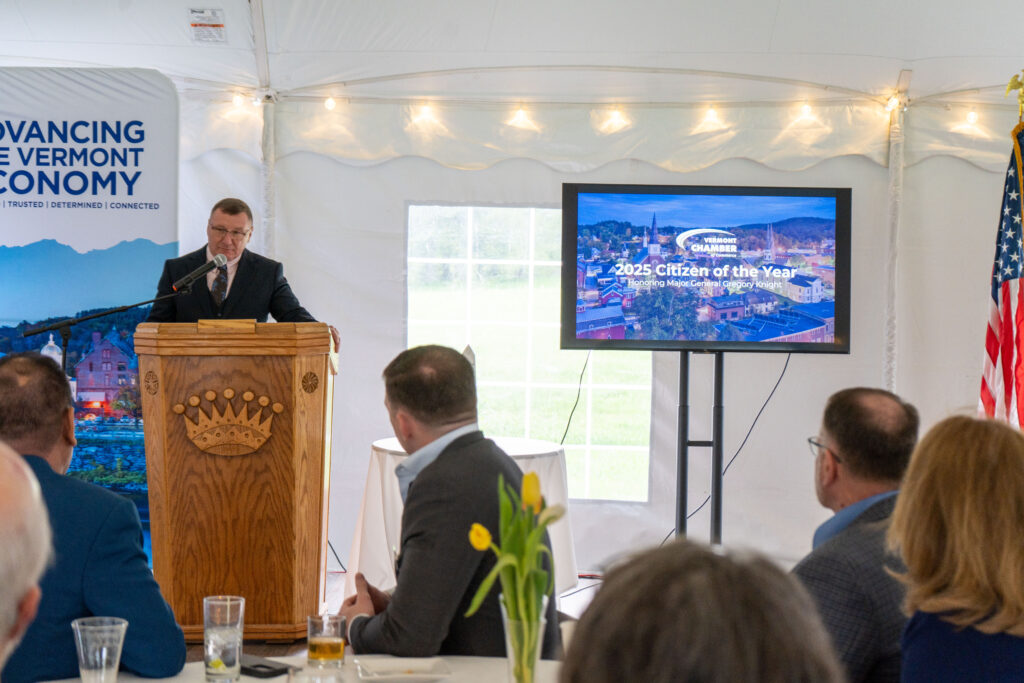
Stowe, VT (May 23, 2025) – On May 21, the Vermont Chamber of Commerce celebrated Major General Gregory Knight, Adjutant General of the Vermont National Guard, as the 2025 Citizen of the Year at an event in his honor. Colleagues, friends, and family members gathered at the historic von Trapp Family Lodge and Resort to recognize Major General Knight’s outstanding contributions to Vermont.

The Citizen of the Year award is presented annually by the Vermont Chamber to an individual who has made significant contributions to the betterment of Vermont, distinguished through exceptional service to their community and region, and epitomizes the true spirit of service and self-sacrifice that defines Vermont citizenship. Major General Knight has exemplified these qualities through his proactive leadership, workforce development initiatives, and dedication to ensuring every soldier and airman feels valued.

“When I look around Vermont in my role as the Adjutant General, I realize Vermont is a very special place. We need more believers in Vermont, and we need to bring more believers—and their talent and experience—here,” said Major General Knight.  “I am convinced more than ever of two things: the excellence of our people and the importance of relationships.”

Amy Spear, President of the Vermont Chamber of Commerce, also shared her thoughts on the occasion, saying, “Those who know General Knight speak of his humility, his accessibility, and his unwavering care for the people he serves— whether they wear the uniform or not. His leadership is rooted in humanity, and it has left an indelible mark not just on the Vermont Guard, but on our entire state.”

Remarks celebrating General Knight were delivered by Kristina von Trapp Frame, von Trapp Family Lodge & Resort, Greg Maguire, Liquid Measurement Systems, Brigadier General Hank Harder, Deputy Adjutant General of the National Guard Association of Vermont, and the Vermont National Guard and Veterans Affairs Legislative Caucus.

The Vermont Chamber of Commerce has been honoring outstanding Vermonters with the Citizen of the Year award since 1964. Previous recipients include Tom Dee, Senator Patrick Leahy, Barbara Snelling, Antonio Pomerleau, and Ken Squier. This year’s celebration was a testament to Major General Knight’s remarkable contributions and his enduring legacy in Vermont. This event was supported by these generous sponsors: von Trapp Family Lodge and Resort, Casella, Greater Burlington Industrial Corporation, Farrell Distributing, the Vermont Agency of Commerce and Community Development, and the Vermont Department of Labor.  

MG Knight standing at a podium speaking to a crowd

Housing Bill Amendment Moves in the Wrong Direction

Housing Bill Amendment Moves in the Wrong Direction

“Bureaucracy is the death of any achievement.” — Albert Einstein

Einstein’s warning feels especially relevant this week as legislative changes threaten to derail a key housing development tool when Vermont needs it most. As the state continues to grapple with a critical housing shortage impacting businesses and communities statewide, lawmakers focused on refining the Community and Housing Infrastructure Program (CHIP), the latest version of a targeted Tax Increment Financing (TIF) model that has been in development for five years. Designed to fund essential public infrastructure like water, sewer, and roads, CHIP is meant to unlock housing projects that would otherwise remain financially unfeasible. However, recent amendments have added layers of bureaucracy and limitations that risk stalling progress at a time when swift, effective action is essential.

The core principle of TIF is that the increase in property tax revenue generated by a new development (the “increment”) is used to repay the infrastructure bonds, leveraging future growth to finance necessary investments. Without this infrastructure, many housing developments cannot financially move forward meaning the new tax revenue wouldn’t exist anyway.

After the House Ways and Means Committee made sweeping changes to the CHIP proposal, a joint hearing was held by the House Commerce and Economic Development Committee and the House General and Housing Committee. Lawmakers who had spent weeks developing the Senate’s policy framework raised serious concerns, as the amendments appeared to create new barriers rather than improvements.

According to Ways and Means, the changes were intended to provide “reasonable guardrails” on the use of education property tax increment. In practice, the added provisions are more restrictive than protective. Key changes include:

  • Housing Percentage Requirement: Mandates 65% of a project’s floor area be housing, limiting flexibility for rural or adaptive reuse projects.
  • Education Tax Retention Rate: Lowers the retention rate from 75% to 60%, with an optional 80% for deeply income-restricted housing, raising viability concerns.
  • $40 Million Cap: Imposes a total annual cap that may disadvantage under-resourced as well as large communities and limit program impact during a housing crisis.
  • “But-For” Test: Requires developers to prove projects wouldn’t proceed without the incentive, adding new hoops to jump through during a well-documented housing crisis.
  • Sunset Date: Introduces a 2028 end date for the standard TIF program without policy committee discussion, creating long-term uncertainty to an established economic development tool.

The Vermont Chamber is deeply disappointed in the direction this bill has taken. The House Ways and Means Committee’s amendments undermine a carefully negotiated policy intended to spur urgently needed housing in communities struggling with affordability. Rather than advancing a tool to meet the scale of Vermont’s affordability and development crisis, the proposal now adds delay, complexity, and uncertainty. In the remaining two weeks of the session, the Vermont Chamber urges legislators to work collaboratively to move this proposal back into a form that meets the moment—with bold, flexible solutions that support all communities in building desperately needed infrastructure that will support all types of housing.

SHARE THIS ARTICLE

RECENT NEWS

Tourism Economy Day Brings Business and Policy Leaders Together at the State House

Tourism Economy Day Brings Business and Policy Leaders Together at the State House

Over 100 tourism and hospitality industry leaders gathered at the State House on April 10 to engage with legislators and raise awareness of the collective contributions of these industries to the Vermont economy. Tourism Economy Day, convened by the Vermont Chamber of Commerce, Ski Vermont and Vermont Specialty Food Association, brought businesses together to advocate for a thriving Vermont visitor economy.

The Vermont visitor economy has a $4 billion annual economic impact and represents 10% of our workforce. In 2023 alone, 15.8 million visitors spent $4.0 billion across lodging, dining, retail, entertainment, recreation, and more. Their spending also contributed $282.3 million in state and local taxes—equivalent to approximately $1,039 per Vermont household. Businesses, legislative leaders, and Administration officials collaborated for a day of advocacy that elevated the collective contributions of the visitor economy to Vermont. Advocacy day highlights included a joint hearing with the Senate Committee on Economic Development, Housing and General Affairs and House Committee on Commerce and Economic Development, a joint resolution recognizing April 10, 2025, as Tourism Economy Day, and an evening food and beverage tasting reception with the Vermont Specialty Food Association.

Rep. Abbey Duke (Chittenden-17), a stalwart supporter of the tourism industry, shared “Vermont’s tourism sector is a cornerstone of our state economy, generating billions in economic activity, supporting tens of thousands of jobs, and enriching our communities. It’s essential for legislators to support policies that foster sustainable growth in tourism, including investments in infrastructure, housing, workforce development, and supporting local businesses.”

“A thriving tourism economy means vibrant communities and a chance for everyone—whether you’re a local or a visitor—to experience the very best of Vermont. However, the industry is facing challenges echoed by so many across the state: an aging declining workforce and a critical housing shortage.” said Amy Spear, President of the Vermont Chamber of Commerce. “It’s crucial that we find a path towards affordability and abundance, improving economic conditions. Vermont’s beauty and charm are undeniable, and together, we can create an environment where both our tourism industry and our communities can thrive for generations to come.”

Business leaders highlighted the following sentiments in their testimonies: the role of tourism supporting Vermont’s economy and communities, the industry’s centrality in providing jobs and making Vermont an appealing destination to both live and visit, and the collective challenges facing businesses in the industry, including: workforce shortages, workforce housing accessibility and affordability, rising taxes and high operating costs and a strained relationship with Canadian neighbors due to federal rhetoric.

“Outdoor recreation is a significant part of Vermont’s tourism economy, driving visits and fueling the economy in many rural parts of our state. In 2023, outdoor recreation accounted for 4.8% of the state’s GDP, or $2.1B annually, and 5.1% of the state’s workforce, according to the US Bureau of Economic Analysis,” said Molly Mahar, President of Vermont Ski Areas Association. “Vermont ranks second only to Hawaii in percent of GDP generated by outdoor recreation, which is largely driven by activities like skiing, snowboarding, hiking, mountain biking, and camping. However, businesses are grappling with workforce and housing shortages, higher costs, and new uncertainty around Canadian visitation levels, which limit growth.”

Additional business and policy leaders that testified were Nina Ridhibhinyo, Director of Programs & Strategy at ECHO, Leahy Center for Lake Champlain, Randy George, Owner of Red Hen Baking Co., Québec Delegate Rene Sylvestre of the Québec Government Office in Boston, Will Kriewald, CEO of Basin Harbor Resort and Boat Club, Abby Long, Executive Director of Kingdom Trails, Kate Trzaskos, Executive Director of Downtown Brattleboro, Vicky Allard, Founder and Executive Chef at Blake Hill Preserves, Steve Wright, President/General Manager at Jay Peak Resort, and Kim Jackson, Director of Communications and Marketing at Vermont Adaptive.

The day ended with a Vermont Specialty Food Association Legislative Tasting, featuring vendors from across Vermont. Karin Cioffi, Executive Director of VSFA shared, “Vermont’s specialty food and beverage producers are a cornerstone of the state’s identity and a driving force behind the visitor experience. Tourists don’t just come for the views, they come to taste Vermont. From handcrafted cheeses to small batch spirits, these products represent the passion, innovation, and resilience of our local businesses. Our evening tasting event at the State House showcased the incredible talent of producers across the state and underscored just how vital this industry is to Vermont’s economy, culture, and continued appeal as a destination.”

Photo Credit for Images 3 and 4: Blake Hill Preserves