Healthcare Affordability and the Cost of Doing Business | Vermont Solutions Summit Policy Roundtable

Healthcare Affordability and the Cost of Doing Business

Vermont Solutions Summit Policy Roundtable

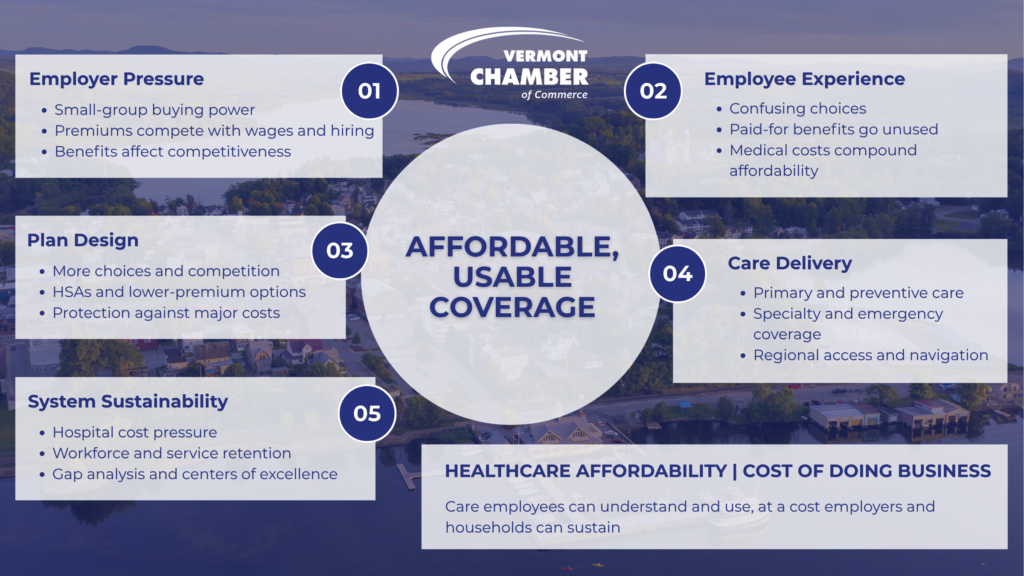
Healthcare roundtable graphic that highlights points made in the article about the 2026 Solutions Summit policy roundtable

At the Vermont Solutions Summit, business leaders, policymakers, and community partners examined how healthcare affordability is affecting employers and employees.

For employers, healthcare is no longer simply a benefits issue. It is increasingly connected to wages, workforce, and competitiveness. Small employers described the difficulty of competing with the purchasing power available to larger groups, while rising premiums can absorb resources that might otherwise support wages, hiring, or investment.

Affordability was only part of the conversation. Participants discussed employees’ declining coverage they do not understand and the need for more choices at different price points, including access to primary and preventive care. At the same time, lower premiums cannot be the only measure of success. Network adequacy, regional access, quality, and provider stability all affect whether coverage works when employees need care.

Complexity adds another challenge. Making coverage easier for employees to understand and use can help them make better use of the benefits already available to them, while hospitals face pressure to reduce costs, retain staff, and preserve services.

Heading into 2027, the discussion emphasized looking at the total cost carried by employers and households, not simply where that cost appears within the system. Participants identified small-group purchasing power, the range and clarity of coverage options, primary and preventive care, regional access, and hospital sustainability as interconnected considerations. The economic objective is coverage that employees can understand and use, and that employers can continue to offer.

Megan Sullivan

Vice President of Government Affairs

Economic Development, Fiscal Policy, Healthcare, Housing, Land Use/Permitting, Technology

RECENT NEWS

Economic Growth, Tax Policy, and Competitiveness | Vermont Solutions Summit Policy Roundtable

Economic Growth, Tax Policy, and Competitiveness

Vermont Solutions Summit Policy Roundtable

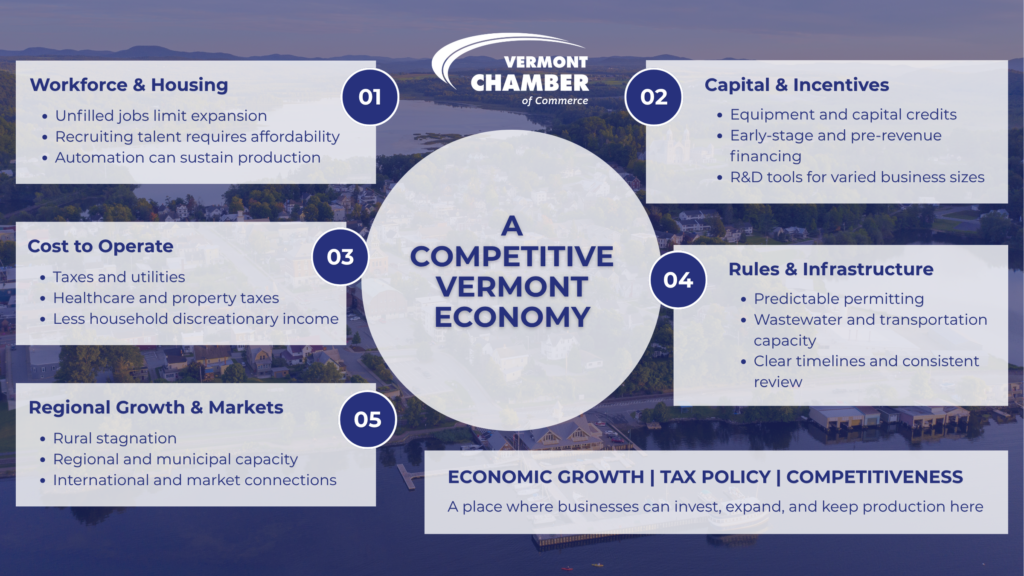
Economic growth roundtable graphic that highlights points made in the article about the 2026 Solutions Summit policy roundtable

At the Vermont Solutions Summit, business leaders, policymakers, and community partners examined how Vermont’s economic development tools align with the conditions businesses are navigating today.

Employers described demand for their products and interest in expanding, but also the realities that can make growth difficult. Workforce shortages and housing constraints can limit hiring, while high operating costs and regulatory uncertainty can influence decisions about where to invest.

Those conditions also affect the role incentives can play. When businesses are already struggling to fill existing positions, incentives tied primarily to adding jobs may have limited value. Participants pointed instead to capital investment, equipment, and automation. Automation was discussed as a way to sustain production, reduce injuries, and keep work in Vermont. The conversation also highlighted different capital needs across business stages, from startups seeking early capital to established employers considering their next investment.

Where that investment occurs has broader economic implications. Participants noted that when production is outsourced or an expansion occurs elsewhere, Vermont can lose supplier activity, payroll, tax base, and the local spending that follows. They also emphasized that incentives alone cannot compensate for delays, overlapping regulation, or infrastructure limitations.

Heading into 2027, the discussion pointed toward better aligning economic development tools with capital investment, research and development, automation, and business stage while maintaining clear measures of public value. It also reinforced the need for a simpler, more predictable path for businesses to invest, expand, and operate in Vermont.

Megan Sullivan

Vice President of Government Affairs

Economic Development, Fiscal Policy, Healthcare, Housing, Land Use/Permitting, Technology

RECENT NEWS

Congresswoman Becca Balint Connects with Vermont Business Leaders at Wellspring Forum​

Congresswoman Becca Balint Connects with Vermont Business Leaders at Wellspring Forum

Conversation focused on affordability, healthcare, housing, and the federal issues impacting Vermont’s economic future

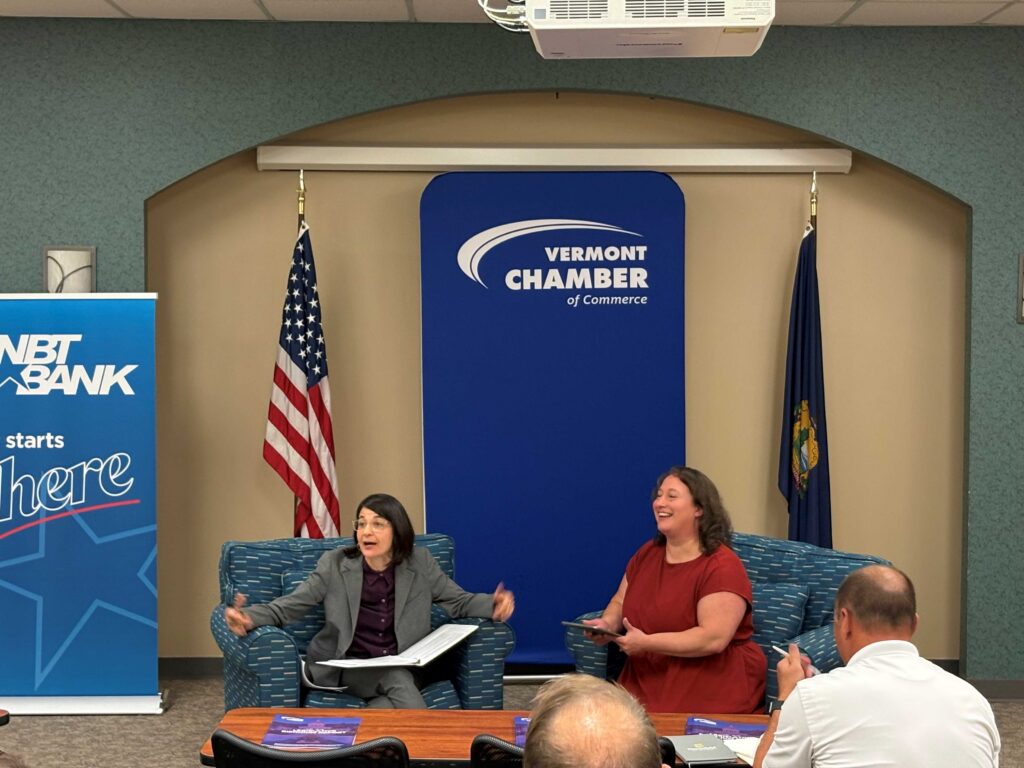
Congresswoman Becca Balint joined Vermont business and community leaders for a Wellspring Forum hosted by the Vermont Chamber of Commerce at Northwestern Vermont Medical Center. The conversation explored the economic pressures facing Vermont businesses and families and the role federal policy plays in affordability, housing, healthcare, and workforce challenges.

The intimate gathering created an opportunity for candid dialogue between Vermont’s sole member of the U.S. House of Representatives and leaders representing employers and communities across the state. Participants shared perspectives on the challenges they are navigating while hearing directly from Congresswoman Balint about her work in Washington and priorities for Vermont.

“Some of the most productive conversations happen when we bring policymakers and business leaders together in a setting where they can speak candidly, ask questions, and better understand one another’s perspectives,” said Amy Spear, President of the Vermont Chamber of Commerce. “The challenges facing Vermont are interconnected, and there is tremendous value in creating opportunities to move beyond talking points and focus on the experiences of the people, businesses, and communities impacted by policy decisions.”

Affordability emerged as a central theme throughout the discussion, connecting concerns about housing, healthcare, and the broader cost of living and doing business in Vermont. Congresswoman Balint discussed issue affecting healthcare costs and housing availability, workforce pressures, and local investment in rural communities. During the open forum, business leaders shared how these pressures are influencing their employees, operations, and ability to plan and grow.

The conversation also explored economic uncertainty, tariffs, and inconsistent government policy making, including how unpredictable government policies create uncertainty that makes it harder for businesses to plan, invest, and make long-term strategic decisions with confidence. Participants discussed the importance of ensuring federal and state policy decisions reflect the realities facing Vermont’s rural communities and small businesses.

“I was grateful to participate in this Wellspring Forum alongside the Vermont Chamber of Commerce and so many important community stakeholders,” said Congresswoman Balint. “From those in attendance, I heard calls for consistency and predictability at the federal level so they can plan, grow, and continue to innovate in their respective sectors. Their stories fuel my fight – now back on Capitol Hill – to relieve the economic pressures folks in Vermont and across the nation are experiencing right now.”

Hosting the forum at Northwestern Vermont Medical Center provided a fitting backdrop for a conversation in which economic vitality and community well-being repeatedly intersected. Healthcare access and affordability, the availability of workers and housing, and the strength of regional employers all contribute to whether Vermont communities can remain in places where people can live, work, and thrive.

The Wellspring Forum Policy Series connects policy leaders with top voices in Vermont’s business community. These invite-only gatherings provide a unique platform for business leaders to engage in meaningful civic dialogue, shape policy conversations, and collaborate on strategies that drive economic progress.

Through Wellspring and other convenings, the Vermont Chamber works to ensure Vermont businesses have opportunities to engage directly with decision-makers while bringing diverse perspectives together around a shared purpose: building a stronger Vermont economy.

CONGRESSWOMAN BECCA BALINT CONNECTS WITH VERMONT BUSINESS LEADERS AT WELLSPRING FORUM
Congresswoman Becca Balint and Vermont Chamber President Amy Spear Lead the Forum Dialog
Jeff Wise

Senior Director of Programming

RECENT NEWS

Vermont Signature Events Program Applications Open for 2027/28

Applications Open for 2027/28 Vermont Signature Events Program

The Vermont Chamber of Commerce and the Vermont Department of Tourism and Marketing (VDTM) have opened applications for the 2027/28 Vermont Signature Events program. 

The Vermont Signature Events program offers an invaluable opportunity for events to garner widespread recognition. The annual program recognizes outstanding events that showcase Vermont’s distinctive character, bring visitors into communities, and contribute to the state’s visitor economy. In 2024, Vermont welcomed an estimated 16 million visitors who spent a record $4.2 billion on lodging, food and beverage, retail, arts and entertainment, recreation, and more. 

A new group of Vermont Signature Events is selected for each program year. The designation does not automatically carry forward, and previously selected events must submit a new application to be considered for 2027/28. 

Eligible events must meet the following guidelines: 

  • Event must take place for a specified and limited period of time. 
  • Events can occur over a period of months (i.e., a special exhibit at a museum) or for just a few hours. 
  • Events must have an end date. 
  • If your business regularly produces events, the event must be above and beyond regular business offerings. 
  • Event must be appropriate for out-of-state visitors as well as Vermont residents. 
  • Event must showcase the unique character of Vermont.  

Award recipients will receive: 

  • A feature in the 2027/28 Vermont Inspiration Guide. 
  • A featured event listed on the VermontVacation Events Calendar. 
  • Inclusion on the VDTM events webpage. 
  • A feature in VDTM’s consumer newsletters. 
  • A feature in VDTM’s social media (stories). 

Eligible events must take place between April 1, 2027, and March 31, 2028.  

Applications are due Thursday, October 1, 2026. 

Learn more about the Vermont Signature Events program and access the 2027/28 application here.

CONNECT WITH OUR TOURISM TEAM

Marc Plouffe

Tourism Sales Account Executive

802-825-8070

Nikki Muir

Tourism Marketing and Sales Manager

802-613-7016

Primary Election Results Begin to Shape the Coming Biennium

Primary Election Results Begin to Shape the Coming Biennium

Vermont’s primary elections offered an early look at the political landscape taking shape for 2027. Most incumbents advanced, while several candidates with previous legislative or statewide experience also secured nominations.

At the same time, legislative retirements will guarantee new leadership next biennium, creating a balance of institutional knowledge and new perspectives.

Economist and political newcomer Amanda Janoo won the Democratic gubernatorial nomination following a highly competitive primary and will challenge Governor Phil Scott in November.

Janoo campaigned in part on reducing Vermont’s reliance on federal funding and supporting increased taxes on higher-income earners. Tax policy and Vermont’s economic competitiveness are likely to remain central issues in the general election and the next legislative session.

Federal funding uncertainty will remain a significant challenge for the next governor and Legislature. The central question will be how Vermont maintains essential services and fiscal sustainability without adding to the affordability pressures already affecting residents and employers.

Former Lieutenant Governor Molly Gray won the Democratic nomination for lieutenant governor and will face Lieutenant Governor John Rodgers in the general election. The race may take on added significance as several competitive Senate contests could influence the balance and dynamics of the next chamber.

Legislative primaries also provided additional clarity in districts experiencing turnover:

  • Chittenden Central: Nikhil Goyal secured a Democratic nomination alongside Senators Martine Gulick and Tanya Vyhovsky for the seat being vacated by retiring Senator Phil Baruth.
  • Orange County: Representative Monique Priestley won the Democratic nomination and will challenge incumbent Senator John Benson.
  • Windsor County: Representative Elizabeth Burrows secured a Democratic nomination for the seat being vacated by retiring Senator Alison Clarkson.
  • Addison County: Senator Ruth Hardy and Democratic nominee Hannah Sessions advanced from the Democratic primary, while incumbent Senator Steven Heffernan secured a Republican nomination.

Why the Elections Matter to Vermont Businesses

For Vermont employers, the implications reach well beyond party balance.

The next Legislature will inherit unresolved questions involving education affordability, taxes, housing, workforce development, health care costs, permitting, federal funding, and economic competitiveness. These issues influence whether businesses can hire, invest, expand, provide competitive benefits, and remain in Vermont.

Retirements will reshape the membership and leadership of key legislative committees. At the same time, the success of many incumbents and candidates with prior government experience could provide continuity on issues requiring significant follow-through.

That continuity matters. Considerable work has gone into developing major reforms and economic strategies, including changes to education governance and finance, health care affordability measures, housing and permitting reforms, and the Vermont Economic Action Plan.

The next biennium presents an opportunity to move from documenting Vermont’s challenges to disciplined implementation and measurable results.

The Vermont Chamber can build on established relationships with returning policymakers while developing productive connections with newly elected legislators. Our approach will remain constructive, nonpartisan, and centered on solutions that strengthen affordability, predictability, and Vermont’s long-term economic vitality.

Much remains unsettled before November. Competitive statewide and legislative races will determine the final composition of the next Legislature and statewide offices and influence which issues receive early attention in 2027.

Regardless of the outcome, the Vermont Chamber will be prepared to work across parties with returning and newly elected policymakers. Our 2027 legislative agenda will be informed by the Vermont Economic Action Plan, the Economic Competitiveness Dashboard, the Vermont Business Climate Survey, and the direct experience of employers across the state.

Together, these resources will help move Vermont from planning to policy to action and advance solutions that make the state a more affordable and competitive place to live, work, and grow a business.

CONNECT WITH OUR GOVERNMENT AFFAIRS TEAM

Jeremy Little

Policy and Outreach Associate

Environment and Energy, Healthcare, Manufacturing, Transportation

RECENT NEWS

New Tariffs Raise Costs and Strain Vermont’s Vital Relationship with Canada

New Tariffs Raise Costs and Strain Vermont’s Vital Relationship with Canada

Canada is more than Vermont’s largest international trading partner. It is our neighbor, ally, and an essential part of our state’s economy, communities, and shared future.

The Vermont Chamber of Commerce is deeply concerned by the escalation of the trade dispute between the United States and Canada. New 50% tariffs on approximately $20 billion in Canadian goods took effect on August 22 following the suspension of trade negotiations between the United States and Canada. Canada has announced that it will match the new tariffs dollar-for-dollar.

The United States has described the tariffs as a response to Canadian trade practices affecting American products in several sectors. Canada has said the negotiations had made significant progress but that last-minute changes to the proposed U.S. terms prevented an agreement.

Regardless of the competing concerns at the negotiating table, escalating tariffs are the wrong outcome for Vermont businesses. Tariffs are collected from U.S. businesses importing covered products and function as taxes on those businesses. The costs can then flow through supply chains, raising prices for families, farmers, and employers on both sides of the border.

A Vital Relationship for Vermont

Vermont’s relationship with Canada is economic, geographic, and personal.

Canada is the state’s largest international trading partner, accounting for more than $600 million in Vermont exports and more than $2 billion in imports in 2024. Vermont businesses rely on Canadian suppliers, customers, visitors, and transportation networks. In some industries, materials and products cross the border multiple times before reaching the final customer.

Canadian visitors also support Vermont lodging properties, restaurants, retailers, attractions, and recreation businesses. Border communities and tourism destinations throughout the state have built relationships with Canadian visitors, businesses, and communities over generations.

This is not a distant international trade issue. It directly affects whether Vermont businesses can manage costs, reach customers, maintain supply chains, and plan for future investment.

An Interconnected Economy

The United States and Canada share one of the most interconnected economic relationships in the world. Supply chains, energy markets, transportation systems, tourism, and consumer markets extend across the border, supporting businesses and workers in both countries.

According to the Canadian government:

  • Canada supplies 99% of U.S. natural gas imports, 85% of electricity imports, and 60% of crude oil imports.
  • Canada is the largest customer for 26 U.S. states and one of the three largest customers for 45 states.
  • Americans sold approximately $436 billion in goods and services to Canadian customers last year, representing nearly $1.2 billion in trade each day.

The energy percentages refer to the share of U.S. imports supplied by Canada, not Canada’s share of total U.S. energy consumption. Energy products are also excluded from this particular round of tariffs. The figures nevertheless demonstrate how closely the two economies are connected and why disrupting that relationship can create consequences well beyond the products directly covered by a tariff.

Higher Costs and Greater Uncertainty

Tariffs are paid by the U.S. companies importing covered products. Those businesses must decide whether to absorb the additional cost, pass it along to customers, renegotiate contracts, change suppliers, or delay investments.

For smaller businesses operating with limited margins and purchasing power, a sudden 50% tariff can be particularly difficult to manage. Even businesses that do not import directly may face higher costs when their distributors, contractors, or domestic suppliers depend on Canadian materials or products. 

The potential effects extend across Vermont’s economy.

Manufacturers may face higher costs for components and materials or encounter new barriers when selling into Canada. Construction companies and developers may see additional pressure on the cost of materials at a time when Vermont is working to make housing more affordable and accelerate development.

Food and beverage producers, farmers, forest products businesses, retailers, transportation providers, and outdoor recreation companies may also be affected by changing prices and trade flows.

The uncertainty surrounding the trade relationship creates an additional challenge. When tariff rates, effective dates, exemptions, and retaliatory measures change quickly, businesses have less confidence when setting prices, negotiating contracts, purchasing inventory, or evaluating future investments.

Retaliation Compounds the Impact

Canada’s decision to match the new tariffs dollar-for-dollar creates additional risks for Vermont businesses that export products into Canada. Retaliatory tariffs can make Vermont goods more expensive for Canadian customers, reduce market access, and create additional costs and uncertainty for businesses and workers on both sides of the border.

The strain can also affect tourism. Canadian visitors have long been an important part of Vermont’s visitor economy. Continued trade tension can influence travel decisions and consumer sentiment, creating consequences for lodging properties, restaurants, retailers, attractions, and communities across the state.

Escalating tariffs and retaliation risk weakening both economies by increasing costs, reducing predictability, and making it more difficult for businesses in both countries to invest and grow.

Regional Relationships Remain Essential

At the 47th Annual Conference of New England Governors and Eastern Canadian Premiers, regional leaders reaffirmed the importance of strong cross-border relationships and more resilient regional supply chains.

Those relationships matter now more than ever. Vermont and eastern Canada share an economy and sense of community built over generations. Businesses, governments, and regional partners must continue communicating and collaborating even as federal trade policies create new challenges.

The Path Forward

The Vermont Chamber supports fair and open trade that strengthens businesses, workers, and communities on both sides of the border. Vermont’s relationship with Canada is too important to allow continued escalation to undermine decades of economic and community partnership.

The Vermont Chamber will continue working with regional partners, monitoring trade developments, and gathering information from Vermont businesses. Direct employer experience will be critical to demonstrating how tariffs and retaliatory measures affect costs, investment, employment, tourism, and competitiveness across the state.

Businesses experiencing tariff related impacts are encouraged to contact the Vermont Chamber’s advocacy team at govaffairs@vtchamber.com.
CONNECT WITH OUR TARIFF EXPERT

Amy Spear

President

Fiscal Policy, Taxation, Tourism and Hospitality, Workforce Development

RECENT NEWS

Vermont Chamber of Commerce Leaders Amy Spear and Megan Sullivan Named Among Vermont’s Most Influential Business Leaders

Vermont Chamber of Commerce Leaders Named Among Vermont's Most Influential Business Leaders

The Vermont Chamber of Commerce is proud to announce that President Amy Spear and Vice President of Government Affairs Megan Sullivan have been recognized by VermontBiz as two of Vermont’s most influential business leaders, an honor celebrating trailblazers shaping the future of Vermont through leadership, innovation, and meaningful impact.

Selected through reader nominations, the VermontBiz 91 Influencers recognition honors individuals whose dedication and vision are strengthening Vermont’s economy, inspiring others, and making lasting contributions to the communities they serve. This year’s recipients were recognized on August 6 at an event in Burlington.

“This recognition reflects Amy and Megan’s unwavering commitment to Vermont’s business community and the collaborative leadership they bring to advancing economic opportunity across our state,” said Sharon Rossi, Chair of the Vermont Chamber of Commerce Board of Directors. “Their work exemplifies the Vermont Chamber’s mission to create a thriving economy by championing policies and partnerships that benefit businesses, communities, and Vermonters.”

As president of the state’s largest business advocacy organization, Amy Spear has earned recognition for her exceptional leadership and steadfast commitment to advancing Vermont’s economy. She brings together employers, policymakers, and community leaders to champion data-informed strategies that strengthen the state’s competitiveness, improve affordability, and foster long-term economic vitality.

As vice president of government affairs, Megan Sullivan is recognized as a trusted and pragmatic policy leader. She works closely with employers, lawmakers, and partners across sectors to advance a member-driven, data-informed policy agenda focused on affordability, competitiveness, predictability, and the long-term vitality of Vermont.

The complete list of 91 Influencers of 2026 is available at vermontbiz.com.

Jeff Wise

Senior Director of Programming

RECENT NEWS

New Regulations and Business Tools Took Effect on July 1

New Regulations and Business Tools Took Effect on July 1

Several new laws and regulatory updates took effect on July 1, bringing a mix of practical tools, reduced barriers, and new compliance obligations for Vermont businesses. While some changes create greater flexibility and predictability, others require employers to prepare for added costs or administrative requirements.

New Tools and Reduced Barriers

  • Nickel Rounding for Cash Transactions: Businesses may now choose to round the final amount of cash transactions to the nearest five cents under a standardized state framework. The law requires a clear notice template to be displayed by all businesses rounding transactions. Electronic payments are not affected.
  • Unemployment Insurance IT Modernization: The Department of Labor rolled out a modernized unemployment insurance system. The updated platform is expected to improve system reliability and reduce administrative burdens for employers and claimants.
  • Alcohol Regulation Modernization: Major provisions of the alcohol bill took effect, loosening regulatory requirements by expanding distribution allowances, shortening the notice period for tasting permits, and removing certain permit-specific hours of sale. These updates reduce regulatory barriers while providing greater flexibility for Vermont’s hospitality and beverage industries.
  • OSHA Hazard Communication Standard: OSHA extended the employer compliance deadline for certain provisions of the 2024 Hazard Communication Standard updates, delaying the applicable deadline from July 20 to November 20, 2026. Employers with workplaces using affected hazardous substances have additional time to update labels, Safety Data Sheets (SDSs), and hazard communication programs before the new requirements take effect.

New Costs and Compliance Risks

  • Bottle Bill Transition: The first phase of Vermont’s bottle bill transition begins July 1, establishing the framework for a Producer Responsibility Organization and increasing the handling fee paid to retailers and redemption centers. Manufacturers, distributors, retailers, and redemption stakeholders should prepare for new reporting requirements and higher operating costs.
  • Liquor Liability Insurance Requirements: Mandatory liquor liability insurance requirements have taken effect for qualifying businesses. While implementation was previously delayed to allow insurance markets additional time to adjust, hospitality businesses should prepare for increased compliance and insurance costs.

The Vermont Chamber Joins Vermont Civic Connect as a Founding Member

The Vermont Chamber Joins Vermont Civic Connect as a Founding Member

The Vermont Chamber of Commerce is a founding member of Vermont Civic Connect, a new program launched by the Vermont Secretary of State’s Office to help businesses and nonprofit organizations improve civic engagement and education across the state.

Vermont Civic Connect provides participating organizations with trusted, nonpartisan information and resources on voting and civic engagement. Employers can use these official resources to help employees access accurate election information and encourage informed civic participation.

“Businesses have a unique ability to foster that sense of belonging by helping employees access trusted, nonpartisan information and creating a culture that encourages participation,” said Vermont Chamber President Amy Spear.

The launch of Vermont Civic Connect complements the Vermont Chamber’s recently released 2025–2026 Legislative Biennium Report, which includes a civic engagement section with nonpartisan resources for employers and employees. Together, these initiatives reinforce the Chamber’s commitment to expanding access to trusted civic information across Vermont.

Businesses and nonprofit organizations committed to improving civic engagement and education across the state are encouraged to learn more about Vermont Civic Connect through the Vermont Secretary of State Services.