Vermont’s 2027 Budget Debate Is Already Taking Shape

Vermont’s 2027 Budget Debate Is Already Taking Shape

The Legislature may not return to Montpelier until January, but the central tension of the 2027 session was already visible at this week’s Joint Fiscal Committee meeting: Vermonters continue to face high costs, state revenues are tightening, and the pressures limiting economic growth have not gone away.

Commissioner of Finance and Management Adam Greshin said the Scott Administration is developing a budget with overall growth of slightly more than 1%. The governor is also expected to propose tax relief as part of his focus on lowering the cost of living, with details coming in January.

For Vermont businesses, the direction of the budget will matter as much as its size. More than 80% of respondents to the Vermont Chamber’s 2026 Business Climate Survey said policymakers do not understand the pressures facing businesses. The Vermont Competitiveness Dashboard adds urgency, ranking Vermont last nationally in economic momentum and near the bottom in workforce retention and population growth.

Vermonters need relief from high costs, and the state must live within its means. The challenge will be ensuring that limited resources are used effectively while advancing policies that allow employers, workers, and communities to grow.

Several committee updates illustrated what is at stake:

  • Fuel costs: Testimony described current conditions as bad for consumers and retailers, with kerosene prices presenting a particular concern. When the cost of heat, housing, health care, and transportation rises, employers feel the effects through recruitment, retention, and wage pressure.
  • Federal work requirements: Approximately 4,000 Vermonters are expected to be affected by expanded federal work requirements for public benefits. The state is conducting outreach to help individuals understand the new requirements and connect them with employment services, training, and practical assistance. Lawmakers also raised concerns that some eligible Vermonters could lose benefits because of paperwork or administrative errors.
  • Housing infrastructure: The Agency of Natural Resources is seeking approval to shift approximately $50 million from drinking water programs to clean water programs, where larger wastewater projects can deploy federal funds more quickly. Water and wastewater capacity is essential to building housing and supporting business expansion.
  • Health care: Approximately $90 million has been obligated through the Rural Health Transformation Program. For employers, the measure of success will be whether funding improves access, strengthens the health care workforce, and produces progress on costs.

The Vermont Futures Project’s Economic Action Plan calls for affordability and abundance, with more people and more places at the center. Without housing and manageable living costs, employers cannot attract workers. Without workers and business growth, Vermont has fewer taxpayers to support its obligations.

That is the risk heading into 2027. Vermont must avoid managing decline by continually dividing fewer resources among growing needs.

This does not require higher taxes or greater overall spending. It requires a sharper focus on results, better use of existing resources, and policy choices that allow the private sector to grow. The upcoming budget debate should be measured by whether it reduces costs today while improving Vermont’s ability to compete tomorrow.


Amy Spear

President

Fiscal Policy, Taxation, Tourism and Hospitality, Workforce Development

RECENT NEWS

Workforce, Education, and Talent Development | Vermont Solutions Summit Policy Roundtable

Workforce, Education, and Talent Development

Vermont Solutions Summit Policy Roundtable

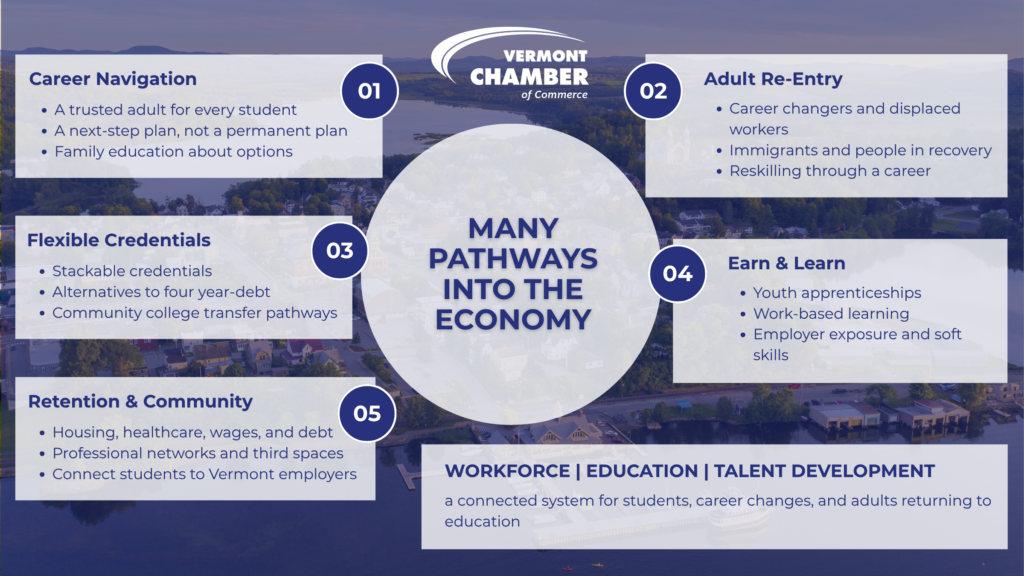
Workforce roundtable graphic that highlights points made in the article about the 2026 Solutions Summit policy roundtable

At the Vermont Solutions Summit, business leaders, policymakers, and community partners examined the scale of Vermont’s workforce challenge and opportunities to connect more people with pathways into and back into the workforce.

Participants cited roughly 5,000 graduating students each year compared with about 17,000 people leaving Vermont’s workforce. The gap underscores why Vermont cannot rely on a single pipeline from education into employment and points to the need for multiple pathways for students, career changers, displaced workers, immigrants, people in recovery, and experienced workers entering new fields.

Participants highlighted promising programs already operating in Vermont, including youth apprenticeships, early college, work-based learning, and industry exposure. The challenge is fragmentation, with access varying by school, location, or awareness of a particular program.

Retention also requires more than a job opening. Housing and healthcare costs can shape whether young Vermonters stay and whether experienced workers move here. Vermont colleges bring thousands of people into the state, but students need meaningful exposure to employers and communities if they are to picture a life here after graduation.

Heading into 2027, participants identified opportunities for a more connected approach, including statewide career navigation, trusted adults for students, replicable apprenticeships, stackable credentials, clearer transfer pathways, and adult reskilling. Participants also called for involving young people directly and measuring which local programs lead to employment and retention. The aim is to make successful pathways visible and available across Vermont while preserving the local responsiveness that made them work.

Megan Sullivan

Vice President of Government Affairs

Economic Development, Fiscal Policy, Healthcare, Housing, Land Use/Permitting, Technology

RECENT NEWS

Permitting, Regulation, and Predictable Investment | Vermont Solutions Summit Policy Roundtable

Permitting, Regulation, and Predictable Investment

Vermont Solutions Summit Policy Roundtable

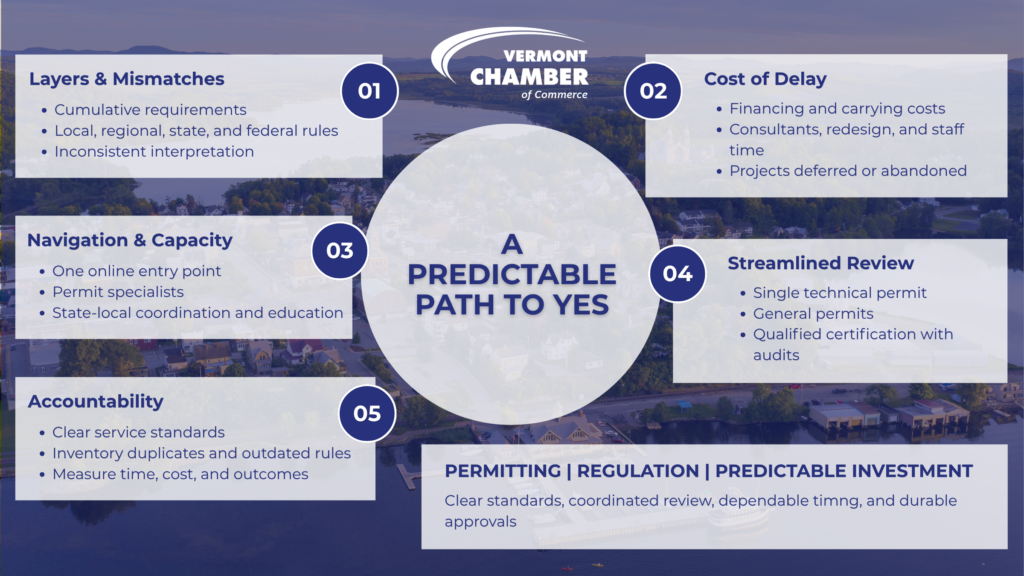
Permitting roundtable graphic that highlights points made in the article about the 2026 Solutions Summit policy roundtable

At the Vermont Solutions Summit, the permitting and regulation roundtable returned repeatedly to one priority: predictability.

Participants did not define success as the absence of standards, but as a system where applicants can understand the rules, navigate reviews in a clear sequence, receive decisions within dependable timeframes, and trust that approvals will not be repeatedly reopened through overlapping processes.

Delays can create significant costs before a project creates a job, home, or tax dollar, including financing, consultants, redesigns, and staff time. Those costs can grow when local, regional, state, and federal requirements overlap or conflict. Participants also noted that some applicants would be willing to pay a reasonable fee for faster, dependable review when the cost of delay is greater.

Ideas discussed included a single online entry point, stronger state and local coordination, review of outdated or duplicative rules, consistent review standards, and greater use of qualified professionals to certify compliant work. A trust-but-verify approach, supported by audits and enforcement, was also discussed to focus limited staff time on more complex or higher-risk applications.

Heading into 2027, the conversation pointed toward moving regulatory reform from a general promise to a defined work plan, with clear responsibilities and measures of whether changes reduce time and cost without weakening environmental or public protections. The clearest outcome was not a call to say yes to every project, but for a navigable path to yes when a project meets clear standards.

Megan Sullivan

Vice President of Government Affairs

Economic Development, Fiscal Policy, Healthcare, Housing, Land Use/Permitting, Technology

RECENT NEWS

Healthcare Affordability and the Cost of Doing Business | Vermont Solutions Summit Policy Roundtable

Healthcare Affordability and the Cost of Doing Business

Vermont Solutions Summit Policy Roundtable

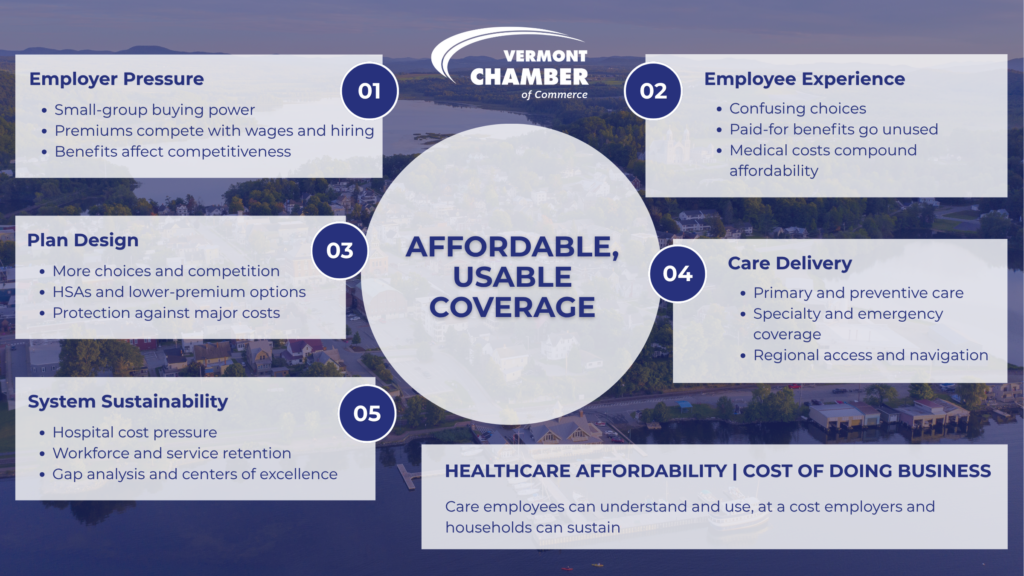
Healthcare roundtable graphic that highlights points made in the article about the 2026 Solutions Summit policy roundtable

At the Vermont Solutions Summit, business leaders, policymakers, and community partners examined how healthcare affordability is affecting employers and employees.

For employers, healthcare is no longer simply a benefits issue. It is increasingly connected to wages, workforce, and competitiveness. Small employers described the difficulty of competing with the purchasing power available to larger groups, while rising premiums can absorb resources that might otherwise support wages, hiring, or investment.

Affordability was only part of the conversation. Participants discussed employees’ declining coverage they do not understand and the need for more choices at different price points, including access to primary and preventive care. At the same time, lower premiums cannot be the only measure of success. Network adequacy, regional access, quality, and provider stability all affect whether coverage works when employees need care.

Complexity adds another challenge. Making coverage easier for employees to understand and use can help them make better use of the benefits already available to them, while hospitals face pressure to reduce costs, retain staff, and preserve services.

Heading into 2027, the discussion emphasized looking at the total cost carried by employers and households, not simply where that cost appears within the system. Participants identified small-group purchasing power, the range and clarity of coverage options, primary and preventive care, regional access, and hospital sustainability as interconnected considerations. The economic objective is coverage that employees can understand and use, and that employers can continue to offer.

Megan Sullivan

Vice President of Government Affairs

Economic Development, Fiscal Policy, Healthcare, Housing, Land Use/Permitting, Technology

RECENT NEWS

Economic Growth, Tax Policy, and Competitiveness | Vermont Solutions Summit Policy Roundtable

Economic Growth, Tax Policy, and Competitiveness

Vermont Solutions Summit Policy Roundtable

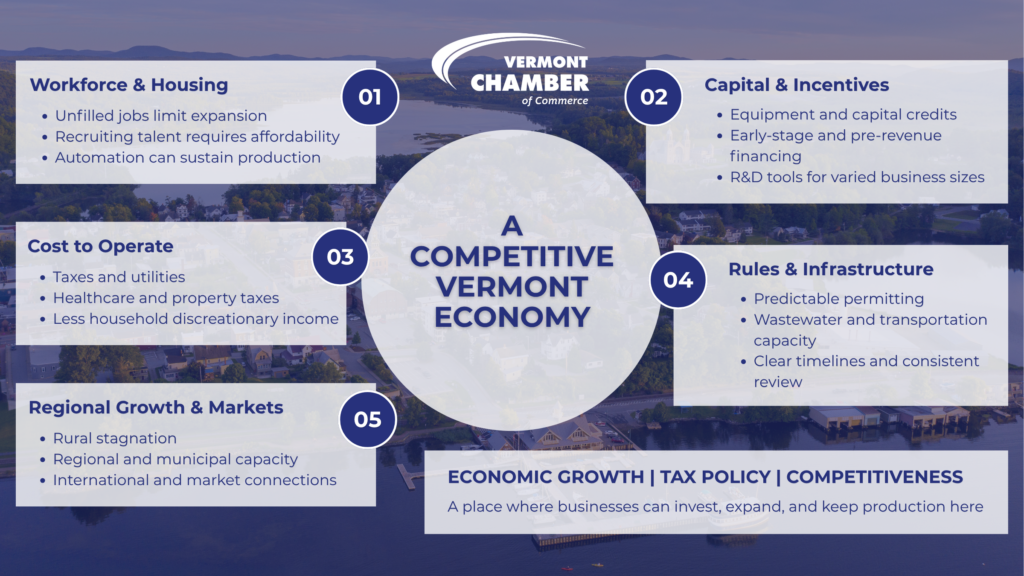
Economic growth roundtable graphic that highlights points made in the article about the 2026 Solutions Summit policy roundtable

At the Vermont Solutions Summit, business leaders, policymakers, and community partners examined how Vermont’s economic development tools align with the conditions businesses are navigating today.

Employers described demand for their products and interest in expanding, but also the realities that can make growth difficult. Workforce shortages and housing constraints can limit hiring, while high operating costs and regulatory uncertainty can influence decisions about where to invest.

Those conditions also affect the role incentives can play. When businesses are already struggling to fill existing positions, incentives tied primarily to adding jobs may have limited value. Participants pointed instead to capital investment, equipment, and automation. Automation was discussed as a way to sustain production, reduce injuries, and keep work in Vermont. The conversation also highlighted different capital needs across business stages, from startups seeking early capital to established employers considering their next investment.

Where that investment occurs has broader economic implications. Participants noted that when production is outsourced or an expansion occurs elsewhere, Vermont can lose supplier activity, payroll, tax base, and the local spending that follows. They also emphasized that incentives alone cannot compensate for delays, overlapping regulation, or infrastructure limitations.

Heading into 2027, the discussion pointed toward better aligning economic development tools with capital investment, research and development, automation, and business stage while maintaining clear measures of public value. It also reinforced the need for a simpler, more predictable path for businesses to invest, expand, and operate in Vermont.

Megan Sullivan

Vice President of Government Affairs

Economic Development, Fiscal Policy, Healthcare, Housing, Land Use/Permitting, Technology

RECENT NEWS