2026 Business Climate Survey

From Business Experience to Policy Action

The 2026 Vermont Business Climate Survey documents how economic conditions are affecting decisions inside Vermont businesses: whether to hire, raise prices, offer benefits, purchase equipment, expand, or invest somewhere else. 

Participating businesses describe an environment in which healthcare costs, workforce availability, housing constraints, taxes, and other operating expenses affect their ability to compete and grow. 

The findings establish a clear mandate for action. Vermont must become more affordable, expand access to workers and housing, create stronger conditions for investment, and ensure that business experience informs policymaking. 

Explore the Data on the Vermont Futures Project Website

2026 AT A GLANCE

2.62 out of 5 

Overall rating of Vermont’s business climate, down from 2.86 in 2025 

59%

Identify healthcare and insurance costs as a major business challenge

57%

Identify workforce availability as a major business challenge

VERMONT'S BUSINESS CLIMATE HAS WEAKENED

Businesses rated Vermont’s overall business climate 2.62 out of 5, compared with 2.86 in 2025. The change is also visible in the distribution of ratings. Forty percent of participating businesses rated Vermont’s business climate a 1 or 2, compared with approximately 29% in 2025. The year-over-year decline suggests that the cumulative effects of rising costs, workforce shortages, housing constraints, healthcare pressures, taxes, regulation, and uncertainty are becoming more difficult for businesses to absorb.

Statewide findings reveal shared challenges, but the effects are not identical across industries.

Accommodation and Food Services

Accommodation and food-service businesses reported greater performance pressure than participating businesses overall.

Forty-eight percent reported declining performance, compared with 28% across other industries. Only 21% expect growth during the coming year, compared with 42% of businesses outside the industry.

Canadian demand is also especially important to the sector, with 82% identifying it as an area of concern.

Manufacturing

Manufacturers reported particularly acute workforce and supply pressures.

Seventy-one percent identified workforce availability as a challenge, compared with 54% of businesses outside manufacturing. Sixty-seven percent cited housing, compared with 45% outside the industry. Eighty-one percent identified the cost or availability of inputs as a concern.

Chart takeaway: Vermont businesses share many challenges, but the intensity and economic consequences vary considerably by industry.

Source: 2026 Vermont Business Climate Survey. Industry findings should be interpreted directionally; see the full report for additional context. 

Sixty-eight percent of participating businesses reported that current trade conditions are having a negative effect on their business.

The most frequently identified concerns include Canadian customer demand, supply-chain disruption, and the cost or availability of inputs. These pressures are especially significant for businesses that depend on cross-border visitors, imported materials, or interconnected regional markets.

Chart takeaway: Trade uncertainty is affecting customer demand, supply chains, and business costs across Vermont’s economy. 

Source: 2026 Vermont Business Climate Survey. 

Eighty percent of participating businesses reported some use of artificial intelligence. 

Most adoption remains limited. Sixty-one percent are using AI in limited applications or pilot efforts, while 19% reported using it across multiple business functions. 

The findings suggest that Vermont businesses recognize the potential of AI, but many are still determining how to integrate it effectively into their operations. 

Chart takeaway: AI use is widespread, but most Vermont businesses remain in the early stages of adoption. 

Source: 2026 Vermont Business Climate Survey. 

Chart takeaway: Vermont’s overall business-climate rating declined, while the share of businesses assigning the state a low rating increased. 

Source: 2025 and 2026 Vermont Business Climate Surveys.

ECONOMIC PRESSURES ARE SHAPING BUSINESS DECISIONS

The survey findings show that current conditions are not simply influencing business sentiment. They are affecting operating decisions. 

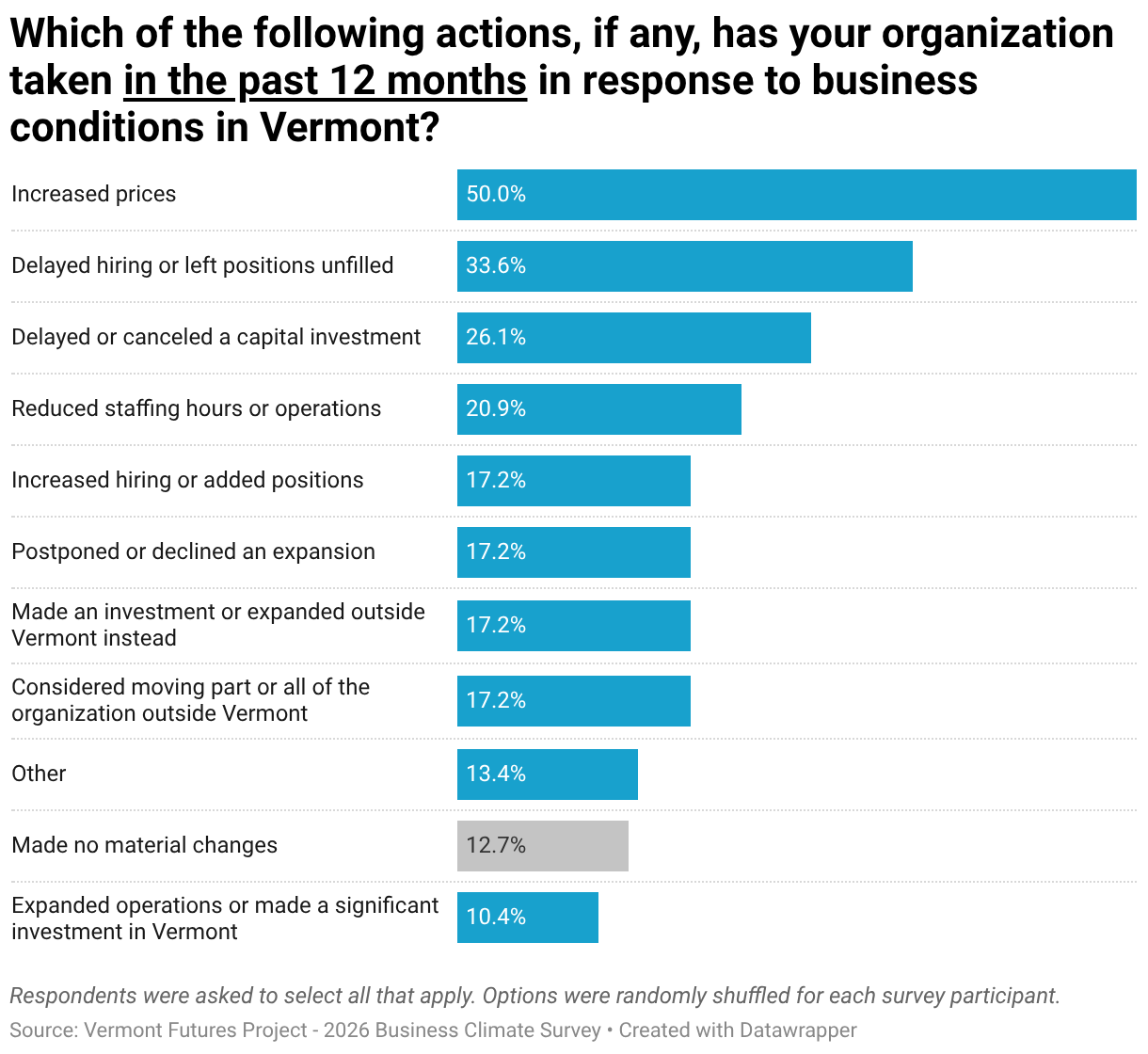
Half of participating businesses raised prices in response to current business conditions. Approximately one-third delayed hiring or left positions unfilled. Others delayed or canceled investments, reconsidered expansion, or invested outside Vermont. 

At the same time, businesses continue to pursue opportunities. Ten percent reported making a significant investment or expansion in Vermont, demonstrating that growth remains possible when businesses have the confidence and capacity to move forward.

Which of the following actions, if any, has your organization taken in the past 12 months in response to business conditions in Vermont? (Bar Chart)

Chart takeaway: Economic pressures are translating into consequential decisions about prices, employment, investment, and where growth occurs. 

CONDITIONS SHAPING VERMONT'S BUSINESS CLIMATE

Affordability is affecting both the cost of doing business and the ability of employees to build a life in Vermont. 

Healthcare and insurance costs emerged as the most frequently identified business challenge, cited by 59% of participating businesses. Healthcare affordability was also the leading individual policy priority, selected by 54%. 

These findings sit within a broader affordability challenge that includes housing, taxes, energy, wages, supplies, and other operating costs. Together, these pressures affect businesses’ ability to hire, invest, expand, and remain competitive. 

Why it matters: Rising costs affect businesses’ ability to invest and grow while making it harder for workers and families to stay and build a future in Vermont. 
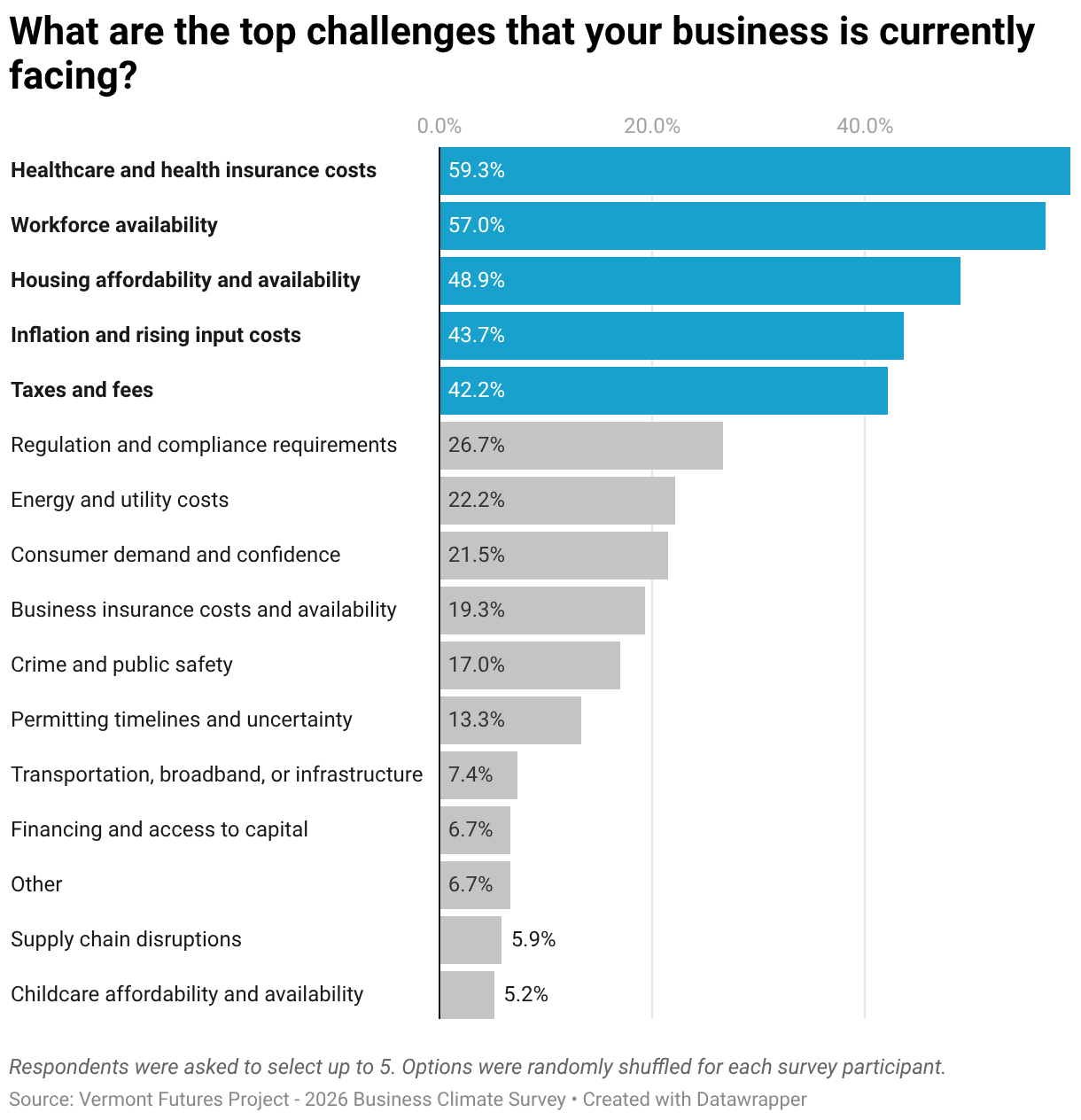
Chart takeaway: Healthcare is the leading individual cost concern, but businesses are experiencing affordability pressures across multiple parts of the economy.  

Workforce availability remains one of the most persistent constraints facing Vermont businesses. Fifty-seven percent identified workforce availability as a major challenge.

When businesses were asked about recruitment, 67% cited the availability of qualified applicants, 53% cited housing availability, and 51% cited Vermont’s cost of living.

The results reinforce a fundamental economic connection: Vermont cannot address its workforce needs without also addressing whether workers can find housing and afford to live in the communities where jobs are located.

Why it matters: When businesses cannot find workers, growth is constrained. When workers cannot find housing or afford to live in Vermont, recruitment becomes even more difficult.
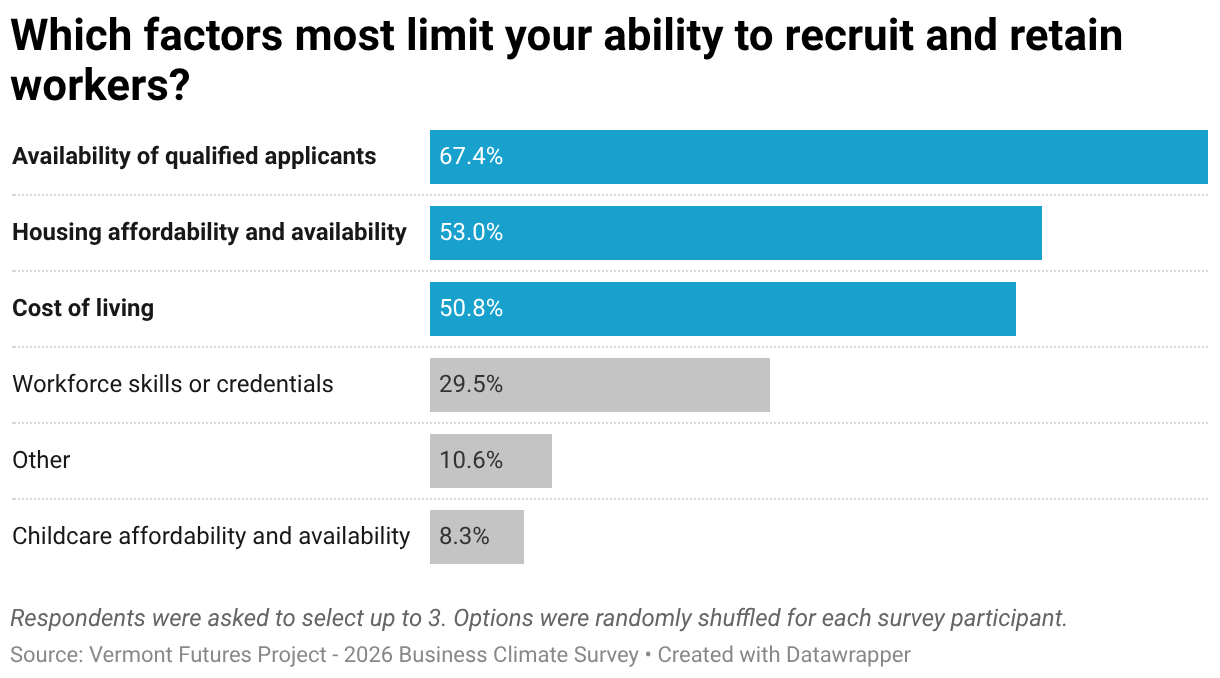
Chart takeaway: The availability of qualified applicants is the leading recruitment barrier, closely followed by housing and the cost of living. 

Business investment depends on more than demand. It also depends on whether businesses can anticipate costs, navigate requirements, and make long-term plans with confidence.

Sixty-eight percent of participating businesses said taxes and fees limit their ability to operate or grow in Vermont. Sixty-two percent identified regulation as a constraint, and 59% cited permitting.

Only 45% described taxes and fees as predictable, while 38% described them as unpredictable.

Investment expectations are mixed. Twenty-one percent expect investment to increase during the coming year, while 20% expect it to decrease. Thirty-three percent expect investment to remain about the same, and another 21% reported no investment in either the previous or coming year.

Why it matters: Greater predictability allows businesses to plan, commit capital, create jobs, and pursue growth with greater confidence.

Chart takeaway: Taxes, regulation, and permitting are widely viewed as constraints, while investment expectations remain divided. 

Business confidence depends partly on whether public decisions reflect an understanding of the conditions businesses are experiencing. 

Sixty-nine percent of participating businesses lack confidence in Vermont’s fiscal stewardship. Seventy-one percent lack confidence that elected officials understand the pressures affecting businesses. 

Fifty-six percent said the business community is not adequately heard in state policymaking, compared with 53% in 2025. At the same time, half said they are comfortable contacting their legislators directly. 

These findings point to both a challenge and an opportunity. Businesses want decisions to reflect economic realities, but meaningful engagement requires accessible channels and a clear connection between business experience and policy development. 

Why it matters: Durable economic policy is stronger when it is informed by the businesses making decisions about employment, investment, and growth. 

Chart takeaway: Most participating businesses lack confidence that state fiscal decisions and policymaking reflect the pressures businesses are experiencing. 

BUSINESS PERFORMANCE PRESENTS A MIXED PICTURE

Current business performance is nearly evenly divided. 

Thirty-seven percent of participating businesses reported growth during the previous year, 32% reported decline, and 31% remained relatively steady. 

Expectations for the coming year are somewhat more positive. Thirty-seven percent anticipate growth, while 19% expect decline. The findings suggest that businesses continue to see opportunities, even as broader concerns about Vermont’s business climate persist.

Chart takeaway: More businesses expect growth than decline during the coming year, but confidence is not shared evenly across the economy. 

Source: 2025 and 2026 Vermont Business Climate Surveys.

A Closer Look at Vermont Businesses

Beyond statewide trends, differences across industries, trade pressures, and technology adoption provide a more detailed picture of business performance and the factors influencing future growth in Vermont.

Statewide findings reveal shared challenges, but the effects are not identical across industries.

Accommodation and Food Services

Accommodation and food-service businesses reported greater performance pressure than participating businesses overall.

Forty-eight percent reported declining performance, compared with 28% across other industries. Only 21% expect growth during the coming year, compared with 42% of businesses outside the industry.

Canadian demand is also especially important to the sector, with 82% identifying it as an area of concern.

Source: 2026 Vermont Business Climate Survey.

Manufacturing

Manufacturers reported particularly acute workforce and supply pressures.

Seventy-one percent identified workforce availability as a challenge, compared with 54% of businesses outside manufacturing. Sixty-seven percent cited housing, compared with 45% outside the industry. Eighty-one percent identified the cost or availability of inputs as a concern.
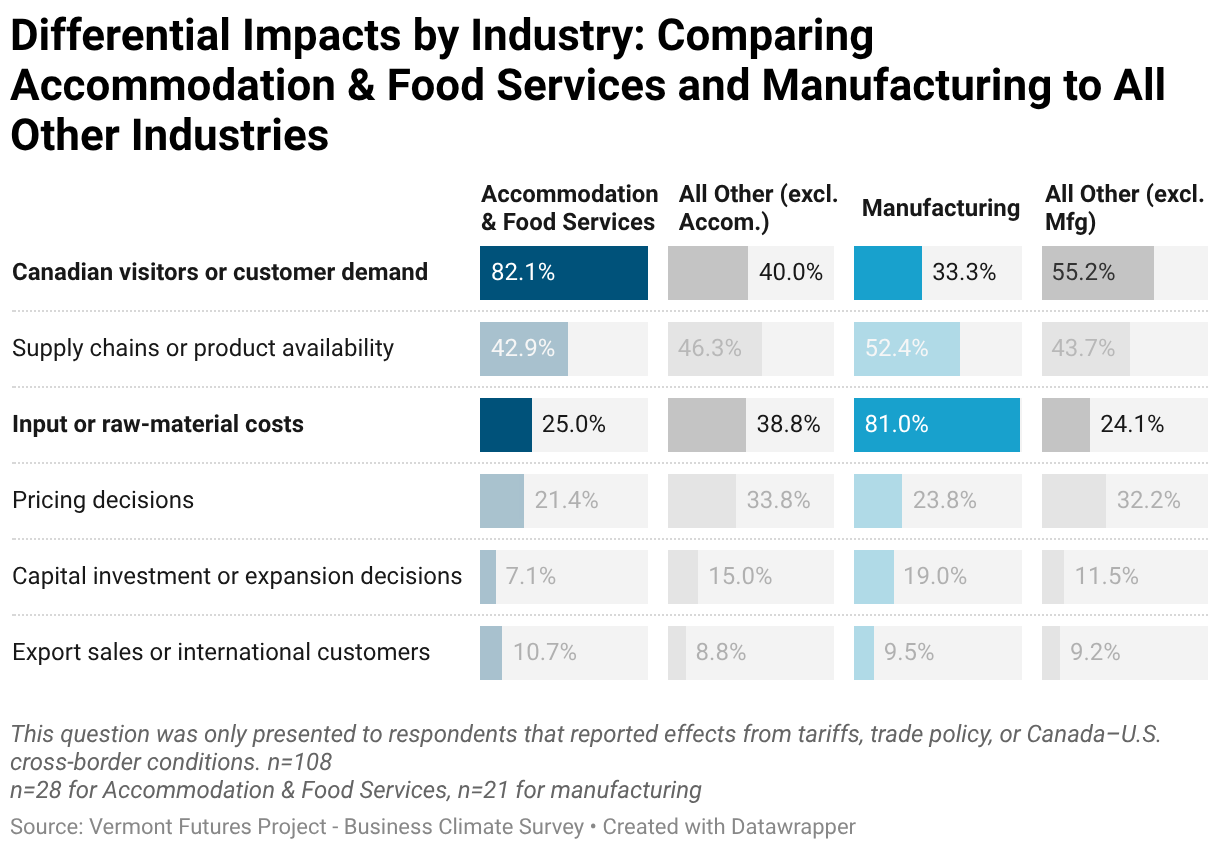
Chart takeaway: Vermont businesses share many challenges, but the intensity and economic consequences vary considerably by industry.

Source: 2026 Vermont Business Climate Survey. Industry findings should be interpreted directionally; see the full report for additional context. 

Sixty-eight percent of participating businesses reported that current trade conditions are having a negative effect on their business.

The most frequently identified concerns include Canadian customer demand, supply-chain disruption, and the cost or availability of inputs. These pressures are especially significant for businesses that depend on cross-border visitors, imported materials, or interconnected regional markets.
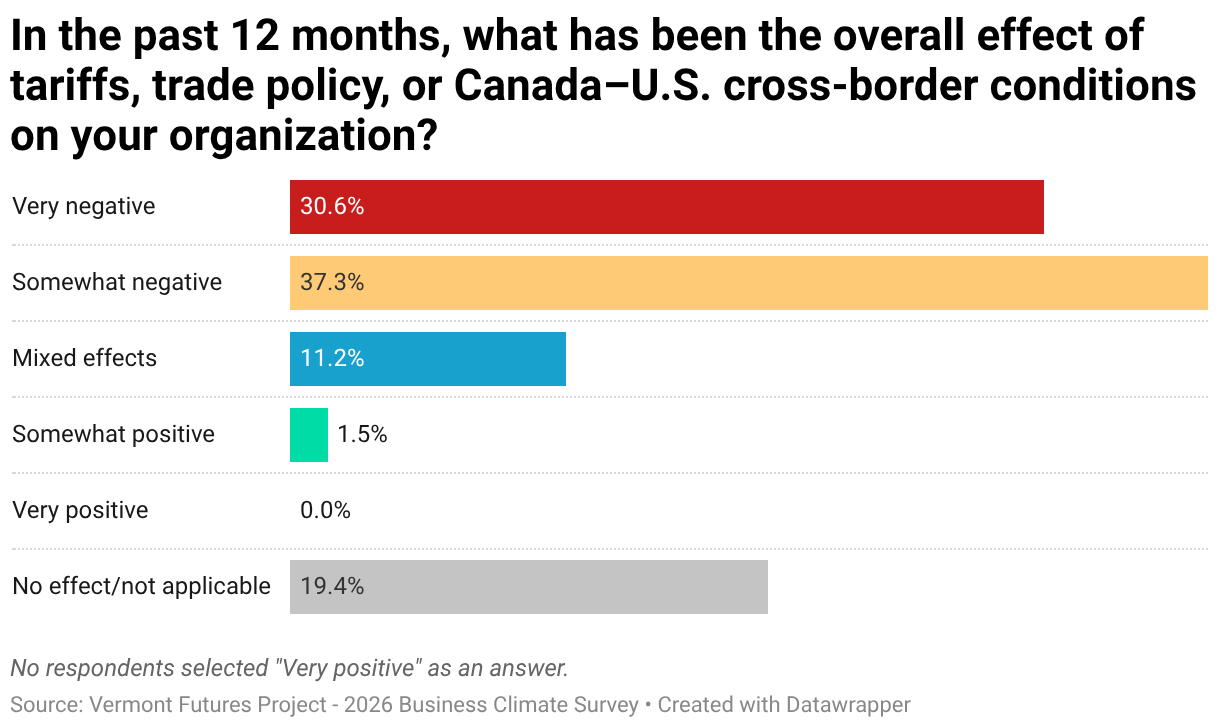
Chart takeaway: Trade uncertainty is affecting customer demand, supply chains, and business costs across Vermont’s economy. 

Eighty percent of participating businesses reported some use of artificial intelligence. 

Most adoption remains limited. Sixty-one percent are using AI in limited applications or pilot efforts, while 19% reported using it across multiple business functions. 

The findings suggest that Vermont businesses recognize the potential of AI, but many are still determining how to integrate it effectively into their operations. 
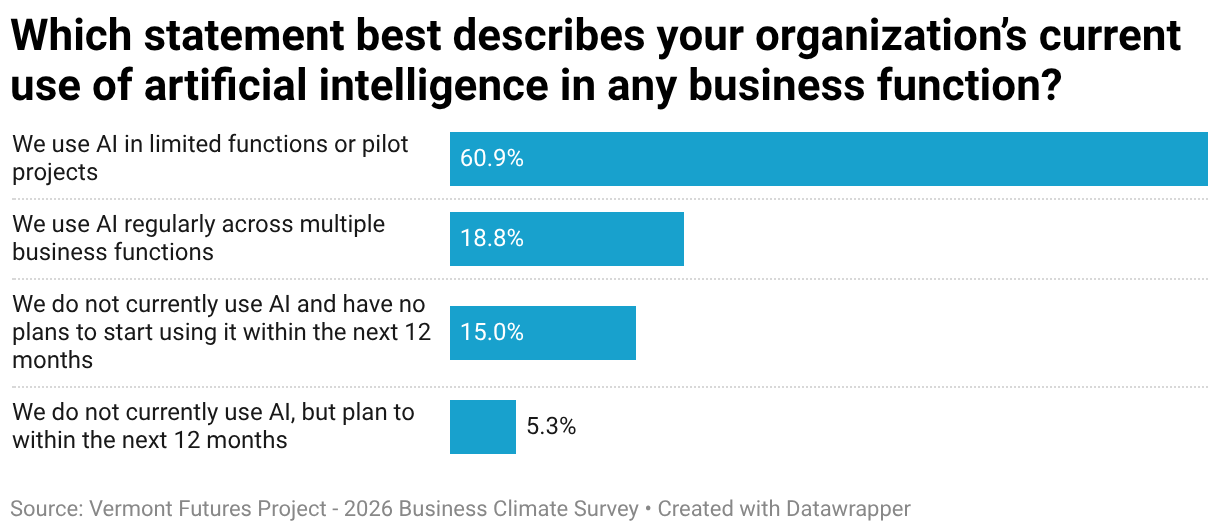
Chart takeaway: AI use is widespread, but most Vermont businesses remain in the early stages of adoption.

FROM FINDINGS TO ACTION

The Business Climate Survey brings the experiences of Vermont businesses into focus. The Vermont Chamber uses these findings, alongside economic data and direct member engagement, to develop its legislative priorities and advance policies that strengthen affordability, growth, and competitiveness. 

This creates a clear connection between business experience and action: 

Business experience → Survey evidence → Legislative priorities → Policy action 

ABOUT THE VERMONT BUSINESS CLIMATE SURVEY

The Vermont Business Climate Survey is an annual statewide survey conducted by the Vermont Chamber of Commerce and the Vermont Futures Project. 

The survey gathers insight from businesses across industries, business sizes, and regions. It examines the conditions affecting business performance, employment, investment, expansion, pricing, and growth. 

The survey is designed to capture one response per business. Results reflect the experiences of participating businesses and should be interpreted as directional evidence rather than a scientific estimate of every business in Vermont. 

Complete information about participation, question bases, and methodology is available in the full report.

FREQUENTLY ASKED QUESTIONS

The Vermont Business Climate Survey is an annual survey examining the economic and policy conditions affecting businesses across Vermont. It tracks business performance, expectations, costs, workforce conditions, housing, healthcare, taxes, regulation, investment, technology, and economic confidence.

The survey is open to Vermont employers and business leaders across every industry, business size, and region. Vermont Chamber membership is not required. The survey is designed for one response per business.

The Vermont Chamber uses the findings to inform its government affairs work, develop legislative priorities, track changes in Vermont’s business climate, and bring credible business evidence into policy discussions. 

The Vermont Futures Project uses the findings alongside broader economic data and the Vermont Competitiveness Dashboard to examine Vermont’s long-term economic performance. 

The full report includes detailed findings, year-over-year comparisons, industry distinctions, visualizations, and information about the survey methodology. 

Download the 2026 Report

The Vermont Business Climate Survey is conducted by the Vermont Chamber of Commerce and the Vermont Futures Project.

STAY ENGAGED

Business experience strengthens the Vermont Chamber’s advocacy throughout the year. Receive updates on the policies affecting Vermont businesses and help inform the solutions we advance in Montpelier.