At the Vermont Solutions Summit, business leaders, policymakers, and community partners examined how Vermont’s economic development tools align with the conditions businesses are navigating today.
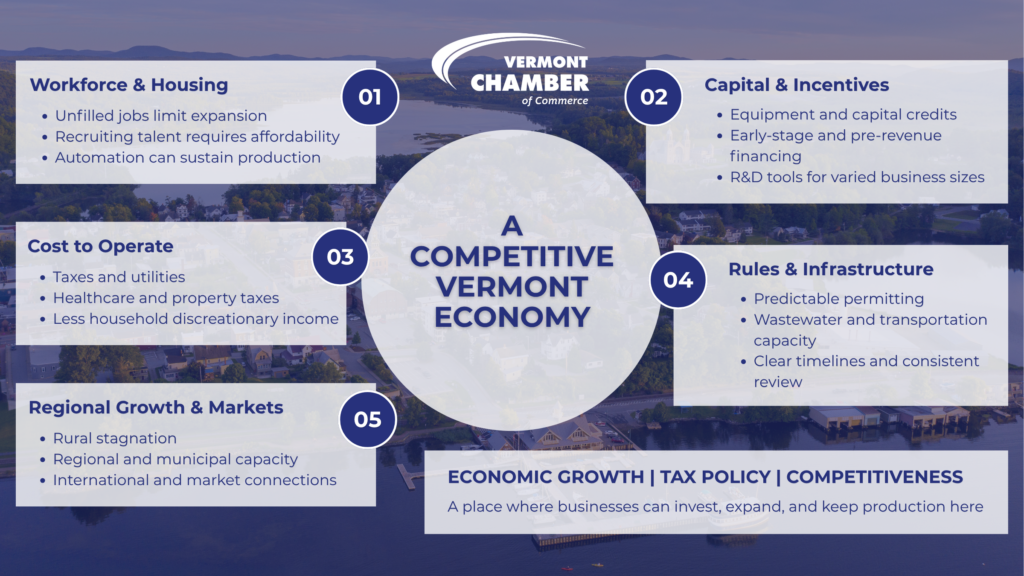
Employers described demand for their products and interest in expanding, but also the realities that can make growth difficult. Workforce shortages and housing constraints can limit hiring, while high operating costs and regulatory uncertainty can influence decisions about where to invest.
Those conditions also affect the role incentives can play. When businesses are already struggling to fill existing positions, incentives tied primarily to adding jobs may have limited value. Participants pointed instead to capital investment, equipment, and automation. Automation was discussed as a way to sustain production, reduce injuries, and keep work in Vermont. The conversation also highlighted different capital needs across business stages, from startups seeking early capital to established employers considering their next investment.
Where that investment occurs has broader economic implications. Participants noted that when production is outsourced or an expansion occurs elsewhere, Vermont can lose supplier activity, payroll, tax base, and the local spending that follows. They also emphasized that incentives alone cannot compensate for delays, overlapping regulation, or infrastructure limitations.
Heading into 2027, the discussion pointed toward better aligning economic development tools with capital investment, research and development, automation, and business stage while maintaining clear measures of public value. It also reinforced the need for a simpler, more predictable path for businesses to invest, expand, and operate in Vermont.
 Megan Sullivan