At the Vermont Solutions Summit, the permitting and regulation roundtable returned repeatedly to one priority: predictability.
Participants did not define success as the absence of standards, but as a system where applicants can understand the rules, navigate reviews in a clear sequence, receive decisions within dependable timeframes, and trust that approvals will not be repeatedly reopened through overlapping processes.
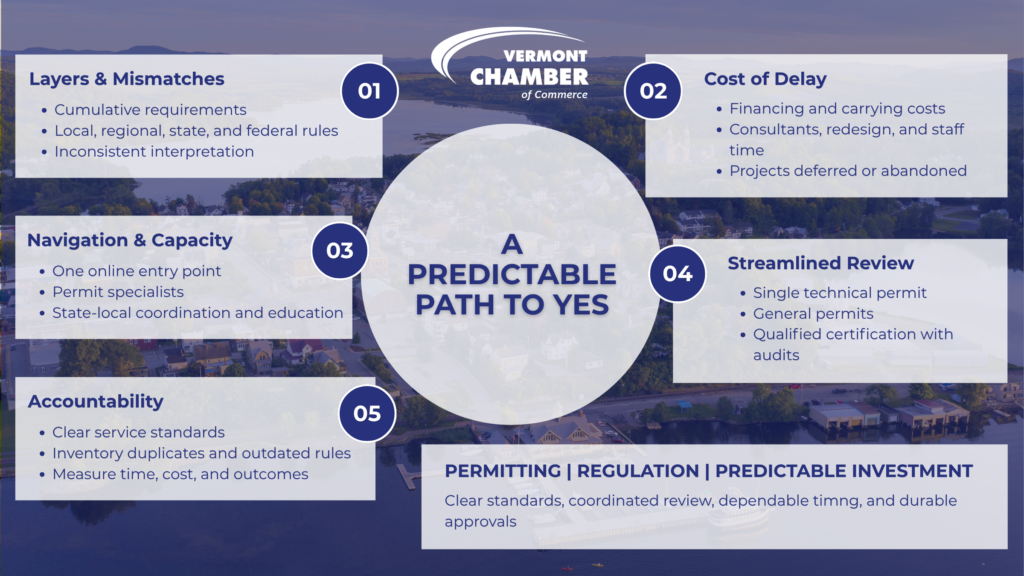
Delays can create significant costs before a project creates a job, home, or tax dollar, including financing, consultants, redesigns, and staff time. Those costs can grow when local, regional, state, and federal requirements overlap or conflict. Participants also noted that some applicants would be willing to pay a reasonable fee for faster, dependable review when the cost of delay is greater.
Ideas discussed included a single online entry point, stronger state and local coordination, review of outdated or duplicative rules, consistent review standards, and greater use of qualified professionals to certify compliant work. A trust-but-verify approach, supported by audits and enforcement, was also discussed to focus limited staff time on more complex or higher-risk applications.
Heading into 2027, the conversation pointed toward moving regulatory reform from a general promise to a defined work plan, with clear responsibilities and measures of whether changes reduce time and cost without weakening environmental or public protections. The clearest outcome was not a call to say yes to every project, but for a navigable path to yes when a project meets clear standards.
 Megan Sullivan