Issue Updates from the State House
Week of February 3, 2026
A weekly snapshot of key legislative activity impacting Vermont’s business community.
- Redistricting Map: After a year of contentious debate over the future of Vermont’s education system, the House Education Committee chair released a proposed redistricting map to move the conversation from theory to a more tangible framework for discussion. Framed explicitly as a starting point, the map sets the stage for stakeholder feedback and upcoming testimony, with key questions around governance, cost pressures, local control, and implementation.
- Omnibus Housing Bill: The Senate Economic Development, Housing, and General Affairs committee continued review of S.328, working to ensure that town housing goals continue to integrate with statewide development targets and continuing to develop an off-site housing construction pilot program that could make it easier to create new housing statewide
- Rural Housing: The House General and Housing Committee continued work on H.775, a multifaceted housing production bill focused on incentivizing small-scale rural development by unlocking new financing tools and reducing barriers for small developers. Committee discussion explored the proposal of an off-site housing construction accelerator pilot program that could lead to more efficient, timely, and consistent home creation.
- Land Use Permitting: The House Environment committee introduced H.805, a bill that would allow Agency of Natural Resources-certified engineers to help streamline wetland and stormwater permitting for projects with minor impacts. Modeled after existing wastewater exemptions, the proposal could improve permitting efficiency.
- Omnibus Alcohol Bill: The House Government Operations and Military Affairs committee combined four alcohol-related bills into a single omnibus alcohol bill that would improve operations for alcohol suppliers by increasing distribution allowances, allowing services in farmers markets, increasing consumption permitted in tasting rooms and retail shops, and improving permitting and hours of service for off-site tasting events.
- Vermont Employment Growth Initiative (VEGI): The Senate Finance and Senate Economic Development, Housing, and General Affairs committees continued review of S.225 and S.327, which would remove the sunset of the VEGI program and preserve access to this key economic development tool.
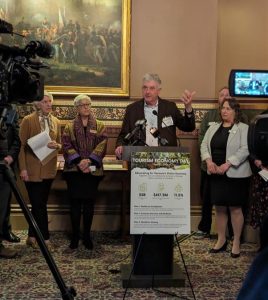
- Outdoor Recreation Day: On Outdoor Recreation Day, committees heard testimony on the outdoor recreation industry’s $2.1 billion contribution to Vermont’s GDP and its support of over 16,000 jobs.
- Health Care: The House Health Care committee continued testimony on H.585, a bill proposing broad reforms to health insurance structures, including the permitting of association health care plans to provide additional choices for employers and self-employed Vermonters. Continued introduction of tools like these remains critical to stabilizing Vermont’s volatile insurance markets and improving affordability for ratepayers.
- Prescription Drugs: The House Health Care committee received updates on legislation passed last session to cap prices on certain prescription drugs to make health care more affordable. The committee also discussed strategies to pool purchasing power and reduce drug costs to help curb systemically high healthcare expenses.
- Budget Adjustment: The Senate Appropriations committee reviewed H.790, the House-passed budget adjustment bill, which makes midyear changes to the FY ’26 state budget. The committee concurred with the House proposal to carry surplus funds into the FY ’27 budget for potential use in a property tax buydown once the broader budget outlook takes shape.
- Education Spending: The Senate Finance committee continued work on S.220, a bill that would align education spending growth with inflation while implementation of education reform takes shape. While recent compromises in the bill allow for more flexibility in extreme circumstances, it remains unclear if the bill will move beyond this committee as debate continues.
- Rodenticides: The House Agriculture, Food Resiliency, and Forestry committee reviewed H.758, a bill that would completely ban the use of rodenticides outside lengthy and narrow waiver procedures for applicators in cases of agricultural, environmental, or public health emergencies. Such a ban could significantly affect facilities management, food safety, and operational costs for businesses across sectors, particularly those in food service, hospitality, and manufacturing.
- Tax Classifications: The House Ways and Means committee continued work on the expansion of property tax classifications from two to three, determining property taxation will be based on percentage of property use within in each category. Significant challenges remain, including the verification of property use attestations, administration and collection of forms, and the cost of implementation.
- Leave Policy (H.459): House General and Housing Committee discussed a policy proposal to stop workers’ compensation leave from running concurrently with Parental and Family Leave. Committee members raised concerns about employer costs, particularly for smaller or benefit-rich employers, and questioned whether the bill was overly burdensome. The committee agreed to have the bill drafted with an employer size threshold for further discussion.
- Flexible Working Arrangements: The Vermont Chamber of Commerce testified before the Senate Economic Development, Housing, and General Affairs committee on S.230, a bill that would shift the onus to employers to prove that flexible working arrangements are unworkable. Vermont has one of the most extensive flexible working arrangement laws in the country and this is a solution in search of a problem.
- Non-Compete: The House Commerce and Economic Development committee continued work on H.205, a bill that would broadly ban non-competes and restricts an employer’s use of retention incentive agreements. The bill continues to be shaped into a more workable proposal.
- Franchises: The House Commerce and Economic Development committee continued work on H.733, a bill that would significantly expand state regulation of business-to-business franchise relationships by limiting termination and renewal rights and imposing mandatory inventory repurchase and transfer requirements. The proposal raises serious concerns about government intrusion into private contracts, added compliance costs, and potential impacts on franchise investment and expansion in Vermont.
- Mediators: The House General and Housing committees advanced H.548, a bill that would create a new state position offering mediation services to both public and private sector businesses and their employees’ collective bargaining units. The bill now moves to the House Floor for consideration
- Career Technical Education (CTE): The Senate Education committee heard testimony on risks of applying broad reform to a diverse system of CTE centers while also considering the complexities of creating real solutions to the problems facing CTE centers. Ensuring CTE centers are properly funded, accessible to students, and integrated with broader education reform remains vital for developing Vermont’s future workforce.
- Event Ticketing: The House Commerce and Economic Development committee continued testimony on H.512, a bill aimed at curbing resale of event tickets to improve event attendance and strengthen protections for venues using online ticketing platforms. Questions remain around potential impacts on face-value reselling platforms and possible exceptions for venue-reseller partnerships
- Purchase and Use: The House Ways and Means Committee reviewed the Governor’s proposal to shift the remaining one-third of vehicle purchase and use tax revenue from the Education Fund to the Transportation Fund over the next three years. This transition is important to meet federal match and road maintenance requirements.
- Meals and Rooms: The Senate Finance Committee reviewed S.286, a bill proposing a 2 percent increase to the rooms and meals tax and further raising costs for businesses in the visitor economy. During review, the committee chair emphasized that significant testimony from impacted industries will be needed.