Amid Severe Workforce Shortage, Paid Family and Medical Leave Program Would Raise Taxes and Further Constrict Workforce Retention

Amid Severe Workforce Shortage, Paid Family and Medical Leave Program Would Raise Taxes and Further Constrict Workforce Retention

Based on a fiscal note from the Joint Fiscal Office, the Paid Family and Medical Leave (PFML) program would be funded by a 0.55% payroll tax. The initial startup cost for the program would require $40.2 million of one-time funding. The annual price tag to administer the program would be $13 million and it would require 45-50 new employees to manage. Along with the extreme cost, it is no secret Vermont is facing a severe workforce shortage and given the state’s difficult history of standing up insurance programs, just the logistics of creating the program would be an uphill battle. The PFML program would provide 12 weeks of leave at 90% wage replacement and no waiting period, going beyond what was passed by the legislature in 2019. The Vermont Chamber continues to testify on the current economic realities facing Vermont business owners, and the potential unintended consequences of a payroll tax on top of the considerable cost involved in the loss of an employee for 12 weeks. 

SHARE THIS ARTICLE

RECENT NEWS

Cost of Childcare is Still Unknown, and Questions Remain Unanswered

Cost of Childcare is Still Unknown, and Questions Remain Unanswered

Nine weeks to the session and the cost and revenue source to pay for one of the legislature’s major priorities remains unclear. When the Chair of the Senate Health and Welfare Committee posed the question of cost, she was met with a resounding silence from advocates, committee members, and the Joint Fiscal Office representative in the committee room. Even following the results of the RAND report, which was commissioned by the legislature for $600,000 to guide their work this session, there is no understanding of how this Senate’s proposal will be paid for. S.56 is expected to remain in committee until next week, leaving the Senate Finance Committee and the Senate Appropriations Committee little time to do their vital work before crossover. The Senate Finance Committee has made it clear they will be considering the cumulative impact of all the major proposals in discussion, which will be essential to ensuring the vitality of the Vermont economy. 

SHARE THIS ARTICLE

RECENT NEWS

Vermont Chamber Convenes Economic Roundtable with Federal Reserve Bank of Boston

Vermont Chamber Convenes Economic Roundtable with Federal Reserve Bank of Boston
© 2023 Federal Reserve Bank of Boston

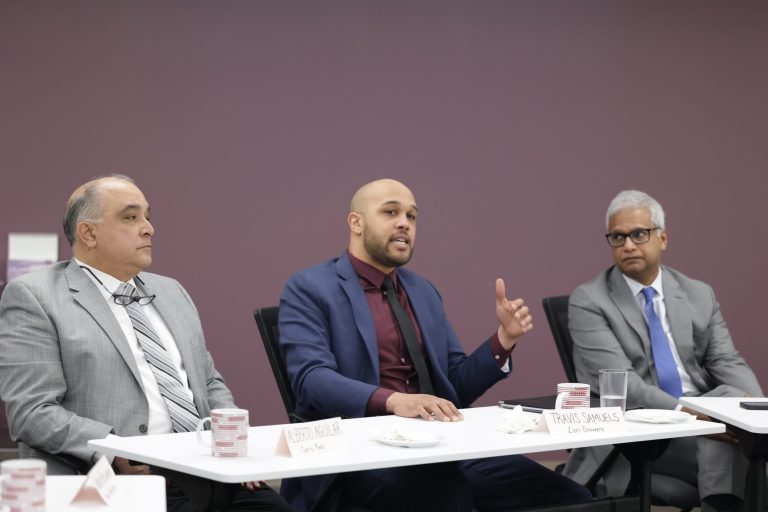
Vermont business leaders met with the President of the Federal Reserve Bank of Boston, Susan Collins at King Arthur Baking Company in White River Junction as part of her ongoing visits around New England to gauge economic conditions. The meeting, convened by the Vermont Chamber of Commerce, provided an opportunity for Vermont business leaders to discuss the state’s economic challenges and opportunities.

President Collins expressed the importance of hearing directly from business owners, to ensure the Boston Federal Reserve has a well-rounded analysis of the state of the economy.

“Reaching out to and interacting with a range of stakeholders has been a priority for me since joining the Boston Fed last year,” stated President Collins. “In addition to hard numbers and surveys, information gathered on the ground about how businesses and workers are faring greatly informs my assessment of economic conditions. The views my team and I hear from around the New England region provide an important window into how well the economy is functioning for everyone.”

“The Vermont Chamber was proud to welcome President Collins to Vermont and connect her with a diverse group of leaders that represent the breadth of business in our state,” said Betsy Bishop, President of the Vermont Chamber of Commerce. “Across industry, county, and size, every business shared how they’ve had to adapt in today’s unpredictable economy. The theme throughout the conversation was the severe impacts of ongoing inflationary pressure.”

Business leaders reflected on the impact of inflation on wage growth and the move toward automation amid the inability to hire workers, as well as the lingering impacts of the pandemic on the economy.

“Revenue is up this year, however, expenses are also up. We have consistently increased our base wages between 20% and 30% each year for the past two or three years,” stated Lindsay DesLauriers of Bolton Valley. “Our operating expenses have also gone up significantly with inflation, so that we are actually behind last year right now on the bottom line. Furthermore, despite the increases we’ve made to wages and efforts we’ve made to add additional benefits, we continue to struggle to find enough staff to hire. While there is much to be proud of and optimistic about, obviously we can’t keep on this inflationary trendline indefinitely.”

“The inability to recruit and retain talent means we can’t fully staff a second shift, let alone add a third shift,” stated Alberto Aguilar of Carris Reels. “Instead, to meet demand we’re exploring how to invest in automation which is becoming crucial to the ability for us to sustain our manufacturing operations here in Vermont.”

“As young business owners, this ‘new normal’ is our reality our challenge” stated Travis Samuels of Zion Growers. “My generation’s attitudes toward work culture, consumerism, and the global supply chain have all changed and we as business owners are having to constantly adapt and pivot. Still, the reality is that there remains a great deal of uncertainty in the economy for newer businesses and it can be difficult to overcome the post-pandemic, financial, and local economic challenges.”

Additional business leaders in attendance; Karen Colberg (King Arthur Baking Company), Mark Foley (Foley Services), Jay Benson (Simon Pearce), Leslie McCrorey Wells (Pizzeria Verità, Trattoria Delia, and Sotto Enoteca), Alberto Aguilar (Carris Reels), Neale Lunderville (VGS), Melvin and Demaris Hall (Global Village), Dr. Sunil “Sunny” Eappen (UVM Medical Center), and Renee Bourget-Place (KPMG – Vermont).
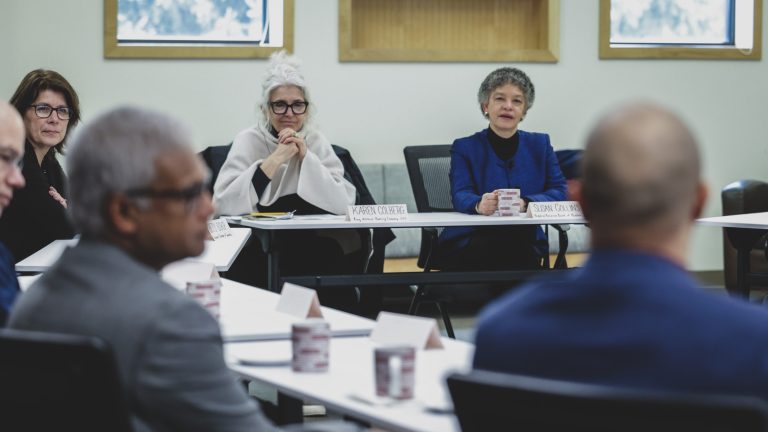
© 2023 Federal Reserve Bank of Boston

SHARE THIS ARTICLE

RECENT NEWS

The Wellspring Forum Features Sen. Ann Cummings, Chair of the Senate Finance Committee, and Rep. Emily Long, House Majority Leader

The Wellspring Forum Features Sen. Ann Cummings, Chair of the Senate Finance Committee, and Rep. Emily Long, House Majority Leader

The successful Wellspring Forum series continues to bring together top Vermont businesses and policy leaders for robust economic discussions. Each event takes place at a unique Vermont business and features new speakers.

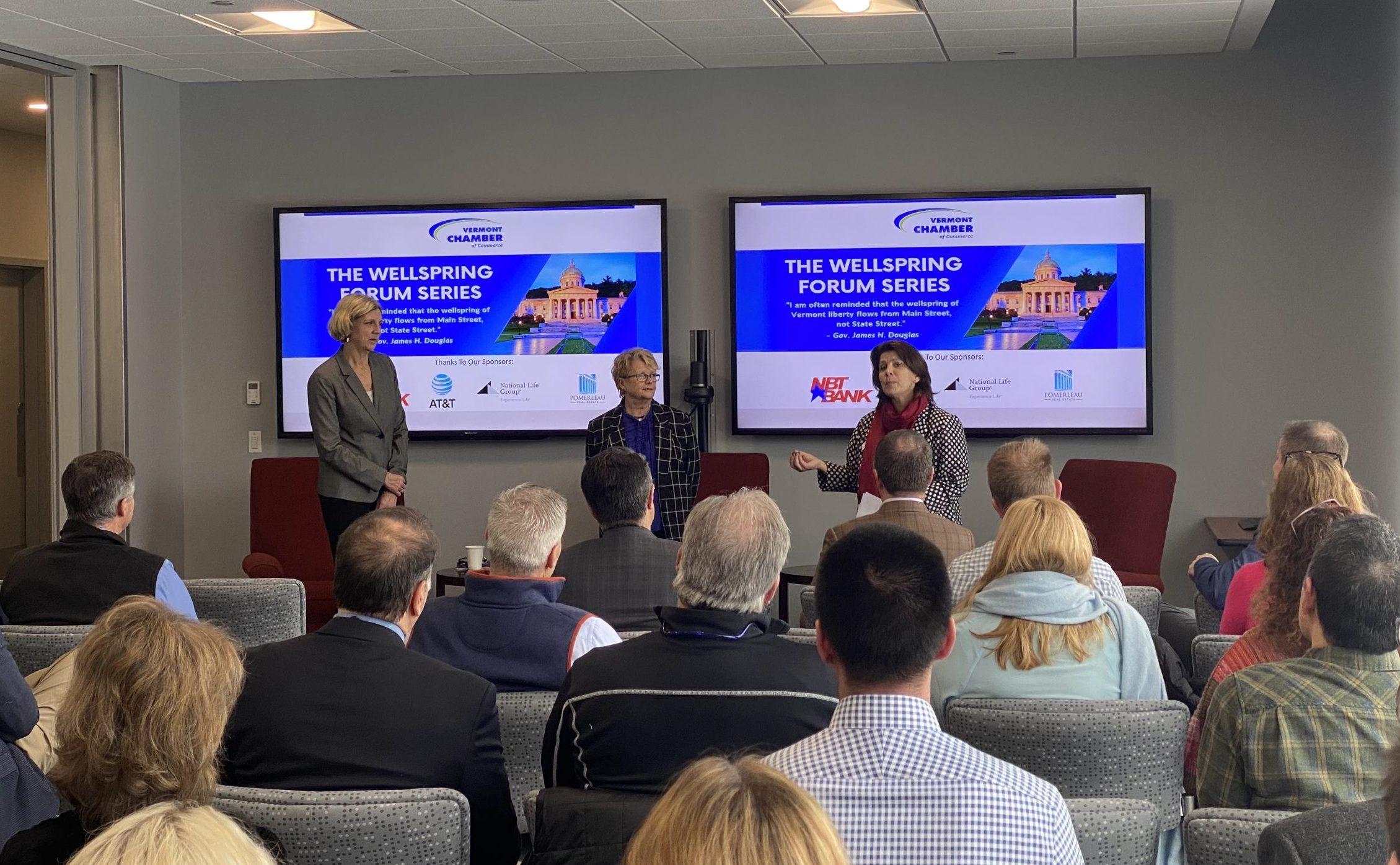
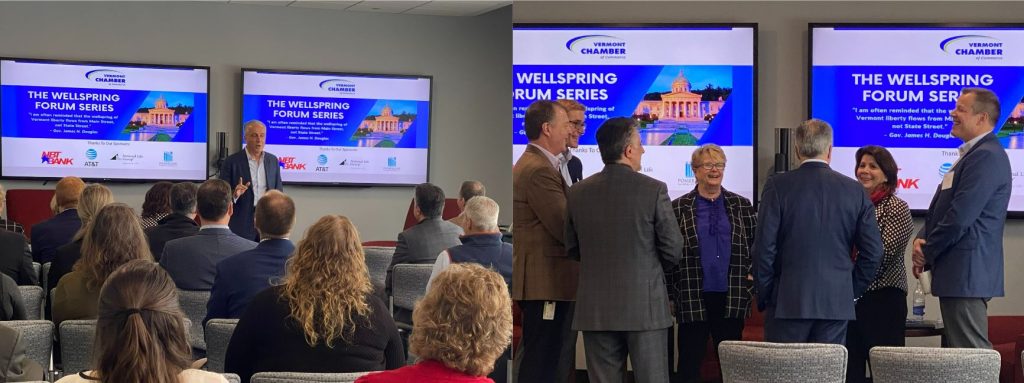
The third event in the series featured the chair of the Senate Finance Committee, Sen. Ann Cummings (D-Washington), and House Majority Leader Rep. Emily Long (D-Windham-5). The legislative leaders addressed the Vermont Chamber Board of Directors and other Vermont business leaders via a moderated conversation with Vermont Chamber President, Betsy Bishop.

In addition to ongoing workforce and housing concerns, the top issue discussed by businesses was the cumulative impact of anticipated tax increases to fund the multiple major proposals in discussion this legislative session. Businesses urged legislative leaders to consider the ability of Vermonters to meet an increased tax demand and the potential for unintended consequences if businesses are unable to do so.

“During a time of great uncertainty, we need to value economic stewardship,” stated Bishop. “As goes the success of small businesses, so often goes the success of our communities. While legislative committees are working on multiple major investments that require new revenue streams, the Vermont Chamber is advocating for pragmatic decision-making, so the Vermont economy is not overwhelmed.”


Sen. Cummings and Rep. Long spoke on several policy issues of interest to Vermont businesses, such as maintaining the small group and individual healthcare markets, solutions to address the ongoing workforce shortage, middle-income housing investments, and the future of the Vermont Employment Growth Incentive program.

“The key to moving policy forward is always balance, and businesses, just like people, sometimes need a lift,” stated Sen. Cummings. “The economy needs to thrive, and the ability to grow business is the difference between Vermont being a place to live and becoming a theme park, only an attraction to visit.”

“Hearing from Vermonters and advocacy groups is critical to the success of what we do,” stated Rep. Long. “I look forward to continuing our collaboration to achieve shared goals. We want to pass a balanced budget that supports Vermonters and businesses in all 14 counties.”

The event was hosted by National Life Group and took place at their Montpelier office.

“National Life has been part of the fabric of this state for 175 years,” National Life Group Chairman, CEO, and President Mehran Assadi said. “The biggest challenge for us is the labor force. We currently have more than 120 open positions to fill.”

The event title is inspired by Governor James H. Douglas’ quote; “I am often reminded that the wellspring of Vermont liberty flows from Main Street, not State Street.”

This Wellspring Forum was made possible by the support of the following sponsors: 

SHARE THIS ARTICLE

RECENT NEWS

CTE Investments Essential to Addressing Workforce Shortages

CTE Investments Essential to Addressing Workforce Shortages

Legislators took testimony this week on the funding and governance concerns that have long restricted the ability to engage more students in Career and Technical Education (CTE). With 70% of the jobs in Vermont not requiring a college degree, the Vermont Chamber sent a letter to key committees advocating for solutions to improve student access to CTE programs to train the next generation of workers for the most in-demand careers.  

Vermont’s workforce shortage is felt most acutely in the trades, where there are too few plumbers, electricians, CDL drivers, and other skilled professionals to meet the demand for services. The need for further investment in CTE programming is underscored by the fact that CTE students are the most likely population to stay in Vermont after completing their education and build long-term careers in their communities. 

SHARE THIS ARTICLE

RECENT NEWS

Total Costs for Childcare Bill Expected Next Week, Two Months into Session

Total Costs for Childcare Bill Expected Next Week, Two Months into Session

The Senate Health and Welfare Committee noted cost implications in S.56 where further discussion will be needed. In doing so, the Chair warned that addressing everything at once would be very costly and that the bill could die under its own weight if there is too much money involved. When the Joint Fiscal Office provides a fiscal note on the cost of each proposal, the remaining proposals in the bill will have to be weighed and prioritized. 

Proposals to address childcare include: 

  • Increase the Child Care Financial Assistance Program (CCFAP) eligibility from 350% to 425% of the poverty level. 
  • Create a tiered professional compensation standard for childcare workers commensurate with public school educators and annual adjustments. 
  • Tie a childcare provider’s participation in CCFAP with the use of this tiered system. 
  • Make payment to a center based on enrollment rather than capacity. 
  • Make a payment schedule that incorporates the total cost of care. 
  • Allow all centers to receive payment regardless of STAR rating so families without access to high-level STAR programs are not disadvantaged from accessing CCFAP. 
  • Create a non-citizen childcare assistance program. 
  • Continue workforce retention grants with $7.3 million in funding. 

Additional related proposals in S.56 address governance and a property tax credit for childcare centers. 

SHARE THIS ARTICLE

RECENT NEWS

Could Universal Public Prekindergarten Be the Key to Childcare?

Could Universal Public Prekindergarten Be the Key to Childcare?

Testimony from the Vermont Principals’ Association in the Senate Education Committee stated there is capacity and infrastructure in place to stand up a high-quality statewide program as outlined in a proposal for universal prekindergarten for 4-year-olds through the public school system. By transitioning an age group to universal public prekindergarten, the proposal could create a significant number of newly available private care provider spots for younger children, addressing availability concerns. 

While the committee response was generally supportive of the program, it was made clear that even with the capacity of schools to implement the proposal now, the only possibility this year would be for a further study on how it would work.  In contrast to private care providers that manage waitlists, public schools accept all students. Additionally, school enrollment has decreased, meaning that the required capacity and infrastructure for the program exists.  

SHARE THIS ARTICLE

RECENT NEWS

Following Supreme Court Decision, S.9 Would Grant Unprecedented Expansion of Power to State Auditor

Following Supreme Court Decision, S.9 Would Grant Unprecedented Expansion of Power to State Auditor

A bill passed the Senate Government Operations Committee that would grant the State Auditor access to any of the books, records, and returns of private businesses that contract with state government as it relates to performance. This would be a significant expansion of authority for the political office. The Vermont Chamber will work to support partner organizations such as the Associated General Contractors of Vermont and Vermont Bankers Association, as well as hospitals and other healthcare organizations, to raise concerns. If this legislation passes, it could lead to lengthy and costly interferences with business operations for any of the thousands of businesses contracting with the state of Vermont and will test the willingness of contractors to work on essential contracts such as hospitals, healthcare providers, construction companies, and information technology companies. 

It remains likely that additional litigation could be expected over the interpretation of what records are related to the performance of an audit. S.9 was voted out of the committee along party lines by a vote of 5-1-0.  Given the importance of contractors, hospitals and financial institutions to the operation of the state government, this bill should be reviewed by additional committees including Senate Transportation, Senate Health and Welfare, and Senate Institutions. 

SHARE THIS ARTICLE

RECENT NEWS

New VEGI Bill Considered Following Vermont Chamber Testimony for Balanced Modernization

New VEGI Bill Considered Following Vermont Chamber Testimony for Balanced Modernization

It became clear this week, to the point of legislators reading from Wikipedia, that consensus could not be reached on a path forward to modernize the Vermont Employment Growth Incentive (VEGI) program. The Vermont Chamber advocated for a program analysis by an established and well-respected third-party. Specifically, one with an understanding of best practices in economic development and without emotional ties to, or against, the program. An updated version of H.10 now has a placeholder for a study contracted by the Joint Fiscal Office or conducted by a legislative panel to look at the structure of the Vermont Economic Progress Council and VEGI. The Vermont Chamber will be advocating for a study modeled on the success of other states like Michigan. 

In stark contrast to those that have evaluated this program in the past, Dr. Ellen Harpel of the Center for Regional Economic Competitiveness provided testimony that highlighted how reviews of incentive programs should be approached and the importance of incentive programs, even for small states with small programs. As the bill progresses, the Vermont Chamber will continue to advocate for a modernized version of the program to ensure the only business incentive program in Vermont is not eliminated. 

SHARE THIS ARTICLE

RECENT NEWS

Business Leaders Testify on Liquor Liability Insurance Concerns

Business Leaders Testify on Liquor Liability Insurance Concerns

To address liquor liability insurance concerns, the Vermont Chamber and Vermont Independent Restaurants (VTIR) are advocating for H.288, legislation that would amend the statutes governing liability for the sale of alcoholic beverages. Vermont’s statutes, which have not been amended since 1987, make Vermont an outlier and undesirable state to insure in. VTIR leadership members Chris Karr of the Killington-based Karr Group and Alex Crothers of Higher Ground testified that if this issue is not addressed urgently, their businesses are at risk of becoming inoperable in Vermont. 

The Vermont Chamber also provided testimony to amend the statute. Specifically, by updating Vermont’s dram shop laws to be in line with neighboring control states such as Maine, and to also remove the landlord from the chain of liability. The current chain of liability includes the server, the business owner, and the landlord.  

SHARE THIS ARTICLE

RECENT NEWS