The Wellspring Forum Features Sen. Ann Cummings, Chair of the Senate Finance Committee, and Rep. Emily Long, House Majority Leader

The Wellspring Forum Features Sen. Ann Cummings, Chair of the Senate Finance Committee, and Rep. Emily Long, House Majority Leader

The successful Wellspring Forum series continues to bring together top Vermont businesses and policy leaders for robust economic discussions. Each event takes place at a unique Vermont business and features new speakers.

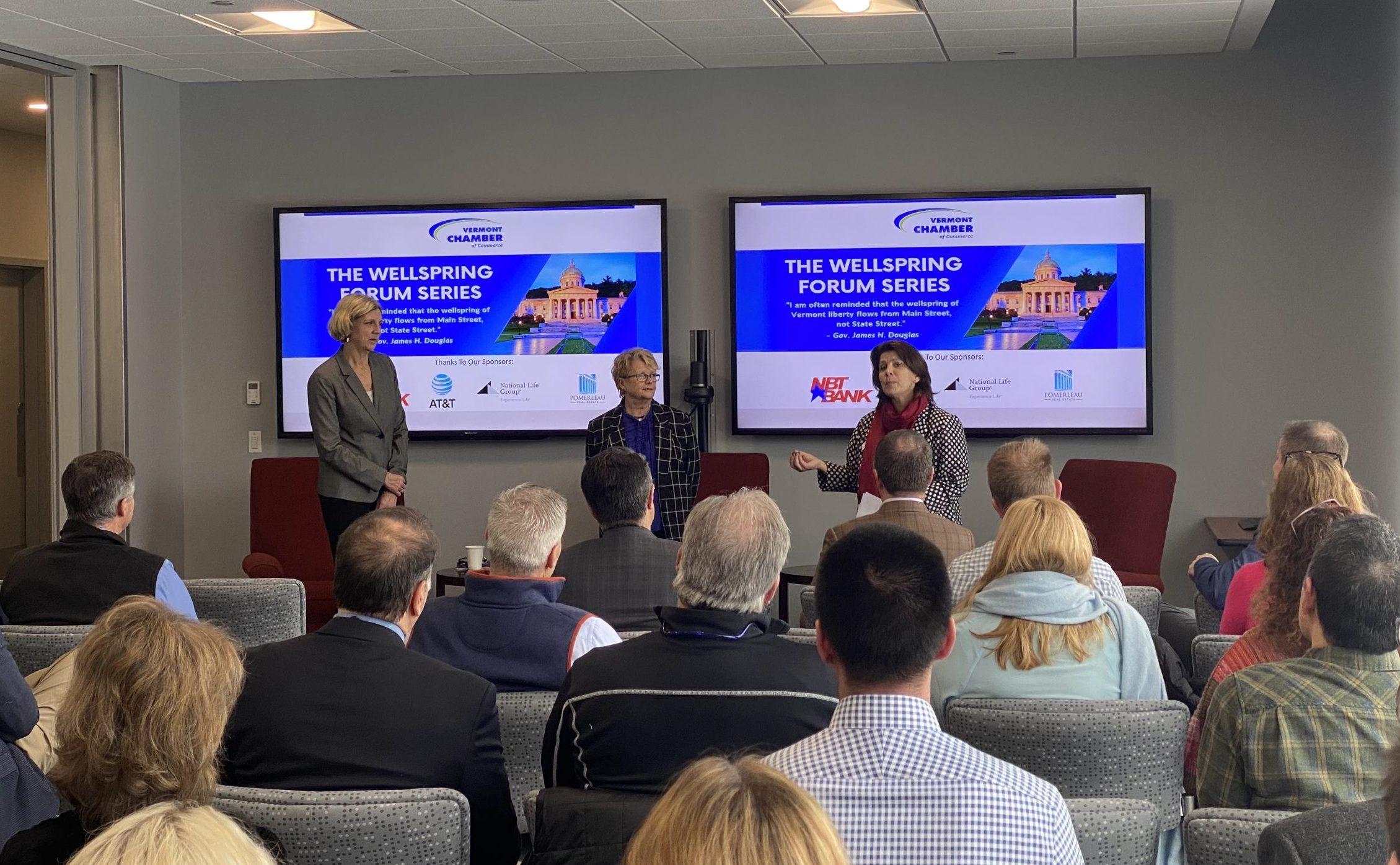
The third event in the series featured the chair of the Senate Finance Committee, Sen. Ann Cummings (D-Washington), and House Majority Leader Rep. Emily Long (D-Windham-5). The legislative leaders addressed the Vermont Chamber Board of Directors and other Vermont business leaders via a moderated conversation with Vermont Chamber President, Betsy Bishop.

In addition to ongoing workforce and housing concerns, the top issue discussed by businesses was the cumulative impact of anticipated tax increases to fund the multiple major proposals in discussion this legislative session. Businesses urged legislative leaders to consider the ability of Vermonters to meet an increased tax demand and the potential for unintended consequences if businesses are unable to do so.

“During a time of great uncertainty, we need to value economic stewardship,” stated Bishop. “As goes the success of small businesses, so often goes the success of our communities. While legislative committees are working on multiple major investments that require new revenue streams, the Vermont Chamber is advocating for pragmatic decision-making, so the Vermont economy is not overwhelmed.”
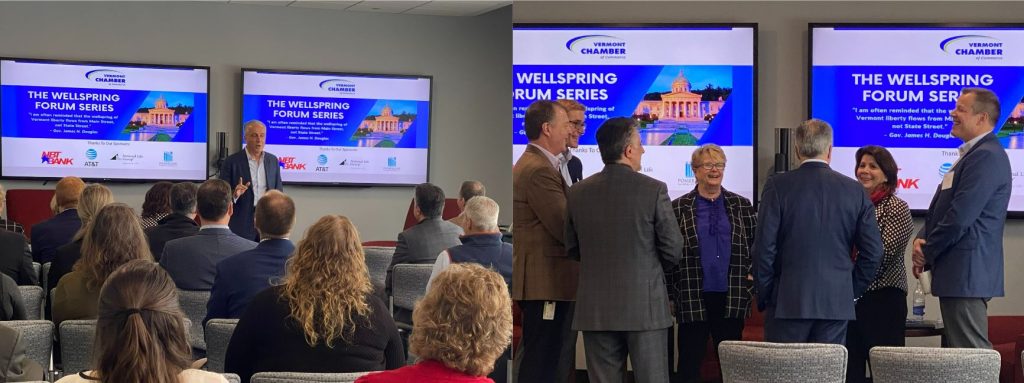
 

Sen. Cummings and Rep. Long spoke on several policy issues of interest to Vermont businesses, such as maintaining the small group and individual healthcare markets, solutions to address the ongoing workforce shortage, middle-income housing investments, and the future of the Vermont Employment Growth Incentive program.

“The key to moving policy forward is always balance, and businesses, just like people, sometimes need a lift,” stated Sen. Cummings. “The economy needs to thrive, and the ability to grow business is the difference between Vermont being a place to live and becoming a theme park, only an attraction to visit.”

“Hearing from Vermonters and advocacy groups is critical to the success of what we do,” stated Rep. Long. “I look forward to continuing our collaboration to achieve shared goals. We want to pass a balanced budget that supports Vermonters and businesses in all 14 counties.”

The event was hosted by National Life Group and took place at their Montpelier office.

“National Life has been part of the fabric of this state for 175 years,” National Life Group Chairman, CEO, and President Mehran Assadi said. “The biggest challenge for us is the labor force. We currently have more than 120 open positions to fill.”

The event title is inspired by Governor James H. Douglas’ quote; “I am often reminded that the wellspring of Vermont liberty flows from Main Street, not State Street.”

This Wellspring Forum was made possible by the support of the following sponsors: 

SHARE THIS ARTICLE

RECENT NEWS

CTE Investments Essential to Addressing Workforce Shortages

CTE Investments Essential to Addressing Workforce Shortages

Legislators took testimony this week on the funding and governance concerns that have long restricted the ability to engage more students in Career and Technical Education (CTE). With 70% of the jobs in Vermont not requiring a college degree, the Vermont Chamber sent a letter to key committees advocating for solutions to improve student access to CTE programs to train the next generation of workers for the most in-demand careers.  

Vermont’s workforce shortage is felt most acutely in the trades, where there are too few plumbers, electricians, CDL drivers, and other skilled professionals to meet the demand for services. The need for further investment in CTE programming is underscored by the fact that CTE students are the most likely population to stay in Vermont after completing their education and build long-term careers in their communities. 

SHARE THIS ARTICLE

RECENT NEWS

Total Costs for Childcare Bill Expected Next Week, Two Months into Session

Total Costs for Childcare Bill Expected Next Week, Two Months into Session

The Senate Health and Welfare Committee noted cost implications in S.56 where further discussion will be needed. In doing so, the Chair warned that addressing everything at once would be very costly and that the bill could die under its own weight if there is too much money involved. When the Joint Fiscal Office provides a fiscal note on the cost of each proposal, the remaining proposals in the bill will have to be weighed and prioritized. 

Proposals to address childcare include: 

  • Increase the Child Care Financial Assistance Program (CCFAP) eligibility from 350% to 425% of the poverty level. 
  • Create a tiered professional compensation standard for childcare workers commensurate with public school educators and annual adjustments. 
  • Tie a childcare provider’s participation in CCFAP with the use of this tiered system. 
  • Make payment to a center based on enrollment rather than capacity. 
  • Make a payment schedule that incorporates the total cost of care. 
  • Allow all centers to receive payment regardless of STAR rating so families without access to high-level STAR programs are not disadvantaged from accessing CCFAP. 
  • Create a non-citizen childcare assistance program. 
  • Continue workforce retention grants with $7.3 million in funding. 

Additional related proposals in S.56 address governance and a property tax credit for childcare centers. 

SHARE THIS ARTICLE

RECENT NEWS

Could Universal Public Prekindergarten Be the Key to Childcare?

Could Universal Public Prekindergarten Be the Key to Childcare?

Testimony from the Vermont Principals’ Association in the Senate Education Committee stated there is capacity and infrastructure in place to stand up a high-quality statewide program as outlined in a proposal for universal prekindergarten for 4-year-olds through the public school system. By transitioning an age group to universal public prekindergarten, the proposal could create a significant number of newly available private care provider spots for younger children, addressing availability concerns. 

While the committee response was generally supportive of the program, it was made clear that even with the capacity of schools to implement the proposal now, the only possibility this year would be for a further study on how it would work.  In contrast to private care providers that manage waitlists, public schools accept all students. Additionally, school enrollment has decreased, meaning that the required capacity and infrastructure for the program exists.  

SHARE THIS ARTICLE

RECENT NEWS

Following Supreme Court Decision, S.9 Would Grant Unprecedented Expansion of Power to State Auditor

Following Supreme Court Decision, S.9 Would Grant Unprecedented Expansion of Power to State Auditor

A bill passed the Senate Government Operations Committee that would grant the State Auditor access to any of the books, records, and returns of private businesses that contract with state government as it relates to performance. This would be a significant expansion of authority for the political office. The Vermont Chamber will work to support partner organizations such as the Associated General Contractors of Vermont and Vermont Bankers Association, as well as hospitals and other healthcare organizations, to raise concerns. If this legislation passes, it could lead to lengthy and costly interferences with business operations for any of the thousands of businesses contracting with the state of Vermont and will test the willingness of contractors to work on essential contracts such as hospitals, healthcare providers, construction companies, and information technology companies. 

It remains likely that additional litigation could be expected over the interpretation of what records are related to the performance of an audit. S.9 was voted out of the committee along party lines by a vote of 5-1-0.  Given the importance of contractors, hospitals and financial institutions to the operation of the state government, this bill should be reviewed by additional committees including Senate Transportation, Senate Health and Welfare, and Senate Institutions. 

SHARE THIS ARTICLE

RECENT NEWS

New VEGI Bill Considered Following Vermont Chamber Testimony for Balanced Modernization

New VEGI Bill Considered Following Vermont Chamber Testimony for Balanced Modernization

It became clear this week, to the point of legislators reading from Wikipedia, that consensus could not be reached on a path forward to modernize the Vermont Employment Growth Incentive (VEGI) program. The Vermont Chamber advocated for a program analysis by an established and well-respected third-party. Specifically, one with an understanding of best practices in economic development and without emotional ties to, or against, the program. An updated version of H.10 now has a placeholder for a study contracted by the Joint Fiscal Office or conducted by a legislative panel to look at the structure of the Vermont Economic Progress Council and VEGI. The Vermont Chamber will be advocating for a study modeled on the success of other states like Michigan. 

In stark contrast to those that have evaluated this program in the past, Dr. Ellen Harpel of the Center for Regional Economic Competitiveness provided testimony that highlighted how reviews of incentive programs should be approached and the importance of incentive programs, even for small states with small programs. As the bill progresses, the Vermont Chamber will continue to advocate for a modernized version of the program to ensure the only business incentive program in Vermont is not eliminated. 

SHARE THIS ARTICLE

RECENT NEWS

Business Leaders Testify on Liquor Liability Insurance Concerns

Business Leaders Testify on Liquor Liability Insurance Concerns

To address liquor liability insurance concerns, the Vermont Chamber and Vermont Independent Restaurants (VTIR) are advocating for H.288, legislation that would amend the statutes governing liability for the sale of alcoholic beverages. Vermont’s statutes, which have not been amended since 1987, make Vermont an outlier and undesirable state to insure in. VTIR leadership members Chris Karr of the Killington-based Karr Group and Alex Crothers of Higher Ground testified that if this issue is not addressed urgently, their businesses are at risk of becoming inoperable in Vermont. 

The Vermont Chamber also provided testimony to amend the statute. Specifically, by updating Vermont’s dram shop laws to be in line with neighboring control states such as Maine, and to also remove the landlord from the chain of liability. The current chain of liability includes the server, the business owner, and the landlord.  

SHARE THIS ARTICLE

RECENT NEWS

Significant Solutions Proposed in Housing Omnibus Bill to Address Business Concerns

Significant Solutions Proposed in Housing Omnibus Bill to Address Business Concerns

In December, the Vermont Chamber hosted a business roundtable with Senator Ram Hinsdale on the need to make housing the top priority this session. As Chair of the committee tasked with crafting a housing omnibus bill, Ram Hinsdale has since championed the needs of businesses. Over the last eight weeks, the committee took testimony from over 100 Vermonters to craft a bill that would make meaningful progress on Vermont’s housing crisis. The Committee unanimously voted out S.100, the “HOME” bill, which thoughtfully addresses many of the areas that the Vermont Chamber has advocating for. However, the bill is now expected to have an uphill battle in the Senate Natural Resources Committee, which has historically opposed removing the barriers that exist to building housing.  

In an op-ed earlier this session, the Vermont Chamber advocated for legislative action in four areas. Highlights of S.100 are categorized into each of these areas: 

Breaking down Barriers 

  • Limits municipal regulations on issues like parking, single-family zoning, ADUs, number of units per acre, height limitations. 
  • Removes the ability for 10 people to appeal a decision of the municipal administrative officer. 
  • Allows municipal administrative offices to approve subdivisions. 
  • Removes the character of an area as a subject of an appeal. 
  • Increases the trigger for Act 250 from 10 units in 5 years, within 5 miles, to 25 units in 5 years, within 5 miles in a designated area. 

Strategic Investment 

  • $20 million for the Missing Middle Income Homeownership Program 
  • $20 million for the Middle-Income Rental Housing Program 
  • $20 million for the Vermont Rental Housing Improvement Program 
  • $25 million for the Vermont Housing and Conservation Board 

Public Private Partnership 

  • Creates opportunities for employers to invest in workforce housing developments through the Middle-Income Rental Housing program. 

Collects Data 

  • Does not contain a rental registry. 
  • Instructs auditors from the State Office of the Auditor or a third-party auditing firm to conduct an audit of the residential housing development and approval process and identify measures and policy changes that will improve the timeliness of residential housing development. 

SHARE THIS ARTICLE

RECENT NEWS

Legislative Intern Spotlight: Jeremy Little

Legislative Intern Spotlight: Jeremy Little

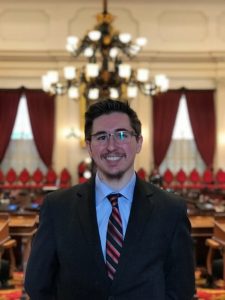
Name:  Jeremy Little 

College: Saint Michael’s College 

Field of Study: Political Science Major, Economics Minor, Spanish Minor

Anticipated Graduation: May 2023 

Hometown: Georgia, VT 

“In this internship, I’m excited to get to know how everything works at the State House. So far, I’ve been lucky to be introduced to many great people who spend their time at the State House, both legislators, lobbyists, and many others. Some of the skills I am developing through this internship include an innate understanding of the legislative process, issues facing Vermonters, and of how the various bills proposed will affect businesses and individuals.  

After graduating, I plan to stay in Vermont and work as a summer canvasser. Following this, I hope to find employment in the fall at a job either directly or indirectly involved in politics within Vermont. At some point, I plan to return to college for a graduate degree in public or environmental policy.  

I look forward to the opportunity to connect. Please reach out if you would like to speak further. This internship is a great opportunity for me, and I welcome the opportunity to deepen my connection with Vermont and with its inner mechanisms.” 

Contact Information:  
Email – 19jslsbhs@gmail.com 

The 2023 Legislative Monitoring Collaborative is made possible by the support of the National Life Group: 

SHARE THIS ARTICLE

RECENT NEWS

Action Required to Address Liquor Liability Insurance Concerns

Action Required to Address Liquor Liability Insurance Concerns

A bill has been introduced to address the issue of why it is so costly, or not possible, for licensees to obtain liquor liability insurance in Vermont. With the help of the House Speaker, this issue has received timely attention. The Vermont Chamber and VTIR will be advocating for legislation that updates state dram shop laws to be in line with neighboring control states. Specifically, by amending the statute so that liability is established on negligence and landlords are removed from the chain of liability in the unlawful sale of alcoholic beverages. Vermont ranks with Alabama as the two worst states for liquor liability insurance.  

Currently, Vermont is an outlier because liability is established on a strict basis and includes the server, owner, and landlord. H.288 proposes to amend the statutes on liability for the sale of alcoholic beverages to reduce the scope of liability and limit the persons who may be subject to an action for damages that result from an unlawful sale of alcoholic beverages. These changes would ensure Vermont businesses do not have to pay exorbitant rates, or, become uninsurable. Initial testimony on this issue was taken by the House Government Operations and Military Affairs Committee.

SHARE THIS ARTICLE

RECENT NEWS