Amy Spear


Program Championed by Vermont Chamber Successfully Deploys $18.5 Million to Vermont Businesses
Program Championed by Vermont Chamber Successfully Deploys $18.5 Million to Vermont Businesses
The VEDA Short-Term Forgivable Loan Program issued business loans to 201 companies in all 14 counties, totaling $18.5 million of funding. This economic development program was successfully advocated for by the Vermont Chamber in the 2022 legislative session and was instrumental for businesses to recover from the pandemic, particularly those in the manufacturing and tourism industries.
The program was fully subscribed to by February 2023. The business relief program provided financial assistance to businesses whose operations were harmed by pandemic-related economic impacts, such as restaurants, lodging properties, and special events vendors, who were forced to close or severely limit their operations.
CTE Report Confirms Need for Significant Reform
CTE Report Confirms Need for Significant Reform
Several committees received a walkthrough of a lengthy report on the funding and governance of Vermont’s career technical education (CTE) system. Study findings suggest that to meet Vermont’s significant workforce needs, “simple changes in the system’s governance or funding will not be sufficient.” To make meaningful progress, the report outlines several recommendations.
The report outlined solutions to be considered in the following areas:
Funding
- Additional funding to incentivize student engagement and make CTE centers more accessible
- Specific funding for facility upgrades to update physical infrastructure and increase capacity
- Implement a weighted student formula, eliminating tuition-based funding
Policy
- Require alignment of academic calendar and requirements by region
- Review teacher requirements and salary policies
State Capacity
- Hire additional Agency of Education staff
- Increase awareness of CTE by requiring career exploration offerings to middle school students
- Eliminate core course repetition and ensure more efficient cost credentialing
Larger Systems Change
- Explore opportunities to expand programming beyond CTE centers
- Coordinate a governance structure by region or single statewide district
Conflict Between Policy and Politics Continues to Obstruct Meaningful Housing Legislation
Conflict Between Policy and Politics Continues to Obstruct Meaningful Housing Legislation
Many legislators in the House appear committed to promises made on the campaign trail to prioritize meaningful action on housing. In particular, a group of legislators in the House General and Housing Committee stood up for their constituents in response to House leadership giving sole jurisdiction on land use, zoning, and Act 250 to the House Energy and Environment Committee. A heated debate on committee jurisdiction ensued, with several committee members concerned that politics is hindering good policy.
Legislators such as Reps. Caleb Elder (Addison-4), Ashley Bartley (Franklin-1), and Saudia LaMont (Lamoille-Washington), fought for the opportunity to have important discussions about regulations that are deeply impacting Vermont’s Housing crisis. Several of these same regulations were supported by the Senate Economic Development, Housing, and General Affairs Committee before being altered by the Senate Natural Resources Committee.
While no action was taken on Act 250, the bill as passed out of the committee does support several programs the Vermont Chamber has advocated for, including the Vermont Housing Improvement Program, the Revolving Loan Fund, and the Missing Middle-Income Homeownership Development Program. The committee ultimately passed the bill out of committee 8-4. The bill will now officially be taken up by the House Energy and Environment Committee to review the bill sections dealing directly with Act 250 and zoning.
Childcare Solutions Must Address Availability, Dependability, and Affordability
Childcare Solutions Must Address Availability, Dependability, and Affordability
The Vermont Chamber testified before the House Human Services Committee on S.56 expressing the need for balanced solutions that will provide the existing workforce with relief from the issues of availability, dependability, and affordability. Legislators must pose critical questions about how, and if, the solutions proposed in the bill address those three areas and if money alone will solve the problem. The Vermont Chamber will continue to raise concerns that amid a severe workforce shortage in every industry, taxing workers and businesses to increase wages for one industry must come with a concrete plan for accountability to ensure more dependability and availability of childcare spots for working families.
The Vermont Chamber continues to advocate in support of not having the availability of CCFAP subsidies tied to the STAR system, and for the legislature to further consider the opportunity for full-time pre-kindergarten to be part of the public school system. Additionally, the Vermont Chamber is urging legislators to consider tax credit opportunities for businesses that are already investing in childcare solutions to ensure employers are not placed in the position of reducing or removing those benefits to cover a tax that may not provide additional solutions for their workers.
Your Voice Matters: Legislature Considering $461 Million of New Taxes and Fees
Your Voice Matters: Legislature Considering $461 Million of New Taxes and Fees
Right now, legislators are considering a sweeping influx of new taxes and increased fees without reflecting on the long-term impacts it will have on their constituents. We are deeply concerned that Vermonters will be unable to weather the nearly half a billion in increased costs over the next two years that the Legislature is poised to pass this session.
We want to be sure Vermonters understand what is being proposed. Currently, the following cost increases have the support of the Legislature:
- Multiple payroll taxes
- Significant increase in DMV fees
- Entirely unknown upfront costs imposed by the Affordable Heat Act
The Legislature is also considering leveraging the following taxes and fees:
- Service Tax
- Cloud Tax
- Professional Regulation Fees
Vermonters are already experiencing inflation, shortages of basic goods due to supply chain disruptions, and scarcity of essential services due to workforce shortages. This is compounded by a severe lack of available childcare and housing statewide. Many legislators believe that now is the time to raise new payroll, business, and consumer taxes to pay for new and expansive programs, but each issue the legislature celebrates comes at a price. Vermont can be a leader on major initiatives without placing an undue burden on voters.
We remain dedicated to advocating for the legislature to pass bills that are rooted in the economic reality of Vermont. Contact your State Representatives and Senators today and encourage them to strike a balance between spending on new programs and taxing Vermonters.
Vermont and Québec Leaders Celebrate a Decade of Collaboration on Trade Corridor
Vermont and Québec Leaders Celebrate a Decade of Collaboration on Trade Corridor
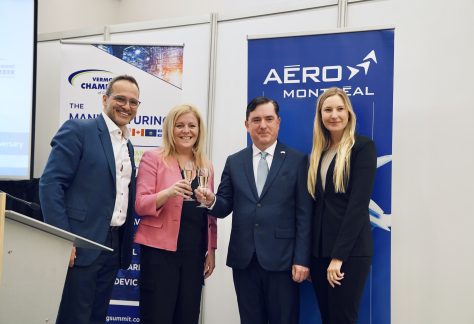
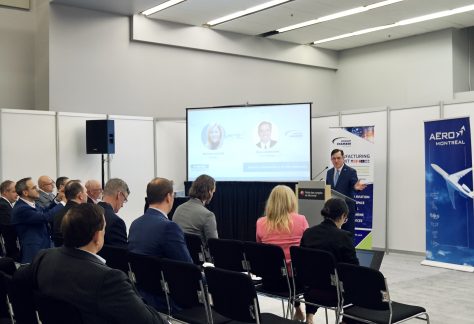
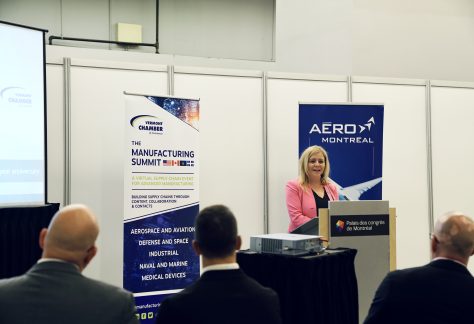
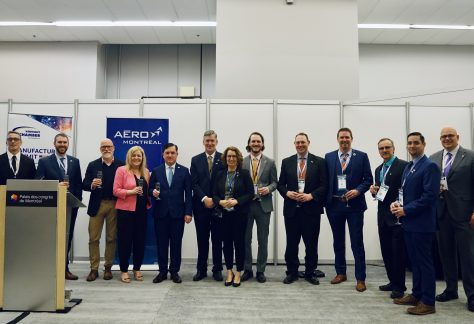
The Vermont Chamber attended Aéro Montréal’s Global Aerospace Supply Chain Summit and BCI’s Aeromart Montréal Tradeshow and Conference for Aerospace and Defense to celebrate the 10th anniversary of a collaboration agreement between Aéro Montréal and the Vermont Aerospace & Aviation Association, a division of the Vermont Chamber. Over the past decade, the Vermont Chamber has championed the Vermont – Québec Aerospace Trade Corridor, which links Vermont’s $2 billion aerospace manufacturing and civil aviation industry with the $17.8 billion Québec aerospace cluster. Recently, the Corridor was extended to include Connecticut and expanded to Ontario.
In both English and French remarks, Chris Carrigan, VP of Business Development for the Vermont Chamber stated, “Over the past decade, the Vermont Chamber and Aéro Montréal have brought our suppliers together to maintain our business relationships and identify new opportunities. We have thus created, over the years, an integrated cross-border supply chain, as well as a regional and international supply chain hub. It unites us not only in business but also to ensure our security and prosperity.”
Mélanie Lussier, President and CEO of Aéro Montreal stated, “Ten years later, I have to say that working with the Vermont Chamber has far exceeded our expectations. For our members, these collaborative agreements ensure access to new markets, innovation, contacts, and aerospace opportunities. I am a firm believer in the continuing power of this collaboration.”
Vermont’s aerospace sector was well represented at the international event, with a delegation featuring Concepts NREC, Dynapower, Lucas Industries, North Country Engineering, Stephens Precision, and Web Industries. Additional key partners attending in support of the trade corridor included the Vermont Agency of Commerce, U.S. Commercial Service, our new Montréal Office for Vermont, CIDEP, Investissement Québec, B2B/2GO, Aerospace Components Manufacturers (ACM), and the Ontario Aerospace Council (OAC).
Legislature Makes Progress on Liquor Law Modernization
Legislature Makes Progress on Liquor Law Modernization
For business owners who are depending on immediate action to ensure they can continue to operate, the Senate’s immediate attention to H.288 issue is essential. The bill was previously passed by the House without contest. The Vermont Chamber testified that the liquor liability legislation be met with the same swift action in the Senate.
Testimony in the Senate Judiciary Committee will continue next week. H.288 would amend the statute by updating Vermont’s dram shop laws to be in line with neighboring control states such as Maine which contains two concepts of liability, one for the negligent service of alcoholic beverages and the other for the reckless service of alcohol. The Vermont Chamber is also advocating for removing the landlord from the chain of liability.
Data Privacy Bill Requires Further Research to Understand Impact on Businesses
Data Privacy Bill Requires Further Research to Understand Impact on Businesses
Members of the House Commerce and Economic Development Committee raised concerns about the structure of a sweeping consumer privacy bill. While legislators are in support of the concept, it’s likely the legislation will not move forward in its current form. The language of H.121 is largely unworkable, raising questions on the ability of small businesses to comply if it were to become law. Instead, the Vermont Chamber will work with legislators on reframing a strong consumer privacy bill that will not lead to unintended consequences for Vermont businesses.
The Vermont Chamber will continue to encourage legislators to thoroughly study and understand this complex issue and consider legislation passed in other states in which data privacy laws balance the protection of consumer privacy with manageable regulation on businesses.
Will the House Make Meaningful Progress on Housing Legislation?
Will the House Make Meaningful Progress on Housing Legislation?
The House took up the Senate’s housing bill this week starting in the House General and Housing Committee. The committee will not be reviewing any provisions related to municipal zoning and Act 250 and will instead focus on housing-specific programs. This would mean a review of changes to state and municipal bylaws will be done in the House Energy and Environment Committee, which historically has been reluctant to address Act 250 barriers. The Vermont Chamber continues to be a leader on the need for bold leadership to reduce barriers to the creation of housing.
Megan Sullivan, VP of Government Affairs for the Vermont Chamber presented to the Rural Caucus, advocating for solutions that make balanced reforms to state and local regulations and alleviate zoning barriers. Additionally, Kevin Chu, Executive Director of the Vermont Futures Project, presented at a Social Equity Caucus on Vermont’s demographic challenges and the role of housing in ensuring an economically secure, sustainable, and equitable future for Vermont.