Ep. 5: “State to Main” – Manufacturing Tax Exemption

Ep. 5: "State to Main" - Manufacturing Tax Exemption

“State to Main” is a policy-focused podcast series complementing the widely read weekly legislative newsletter of the same name.

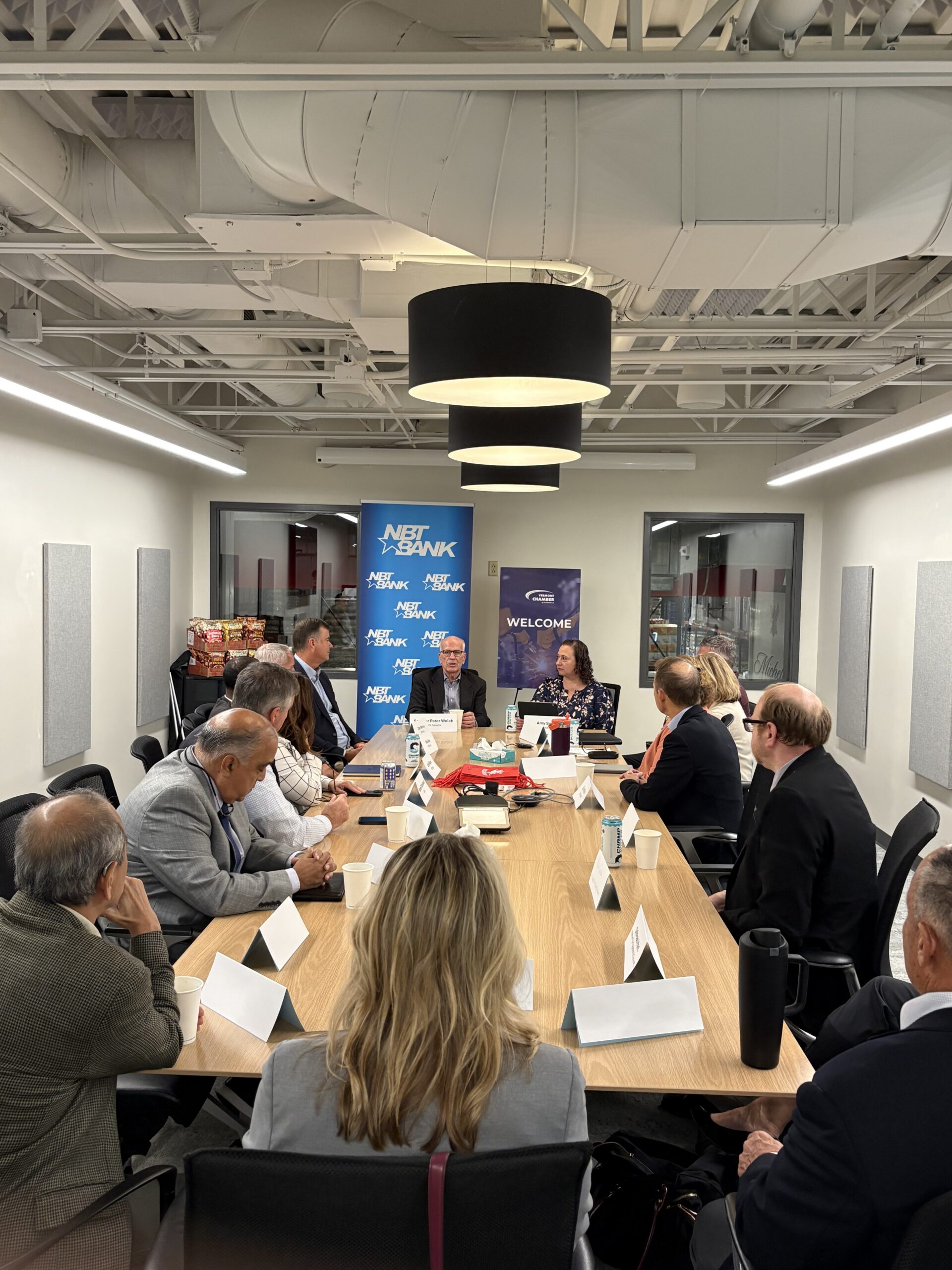
In this episode we welcome Chris Carrigan, Vice President of Business Development for the Vermont Chamber of Commerce, and Julia Birnn Fields, owner of Birnn Chocolates of Vermont, to discuss recent advocacy efforts on the manufacturing tax exemption.

Episodes are available to stream online via Spotify, Apple Podcasts, Soundcloud and on the Vermont Chamber of Commerce website.

“State to Main” is made possible by our sponsor, AT&T.

A New Normal: The 2022 Legislative Session in Review

A New Normal: The 2022 Legislative Session in Review

This commentary is by Betsy Bishop, President of the Vermont Chamber of Commerce, and Megan Sullivan, Vice President of Government Affairs

Each year, the end of the legislative session coincides with warmer weather, signaling peak tourism season just around the corner. For many Vermont businesses, however, this will be the third summer in a row that they are overwhelmed with uncertainty instead of anticipation. While elected officials resumed in-person operations at the State House, the Vermont business community is still working to determine their “new normal.”

The foundation of the Vermont Chamber advocacy this session was the stark reality that Vermont has an estimated 26,000 job openings and an unemployment rate of 2.7%. With 25,500 fewer people participating in the workforce than pre-pandemic, employers are going to unprecedented lengths to retain employees and recruit new workers.

While businesses continued to battle the ongoing impacts of the pandemic, including a constrained labor force, increased payroll expenses, reduced hours, 8.3% inflation, and endless supply chain problems, progress was made on many policy fronts due to the support from legislators who listened to our members and our dedicated five-person Vermont Chamber advocacy team.

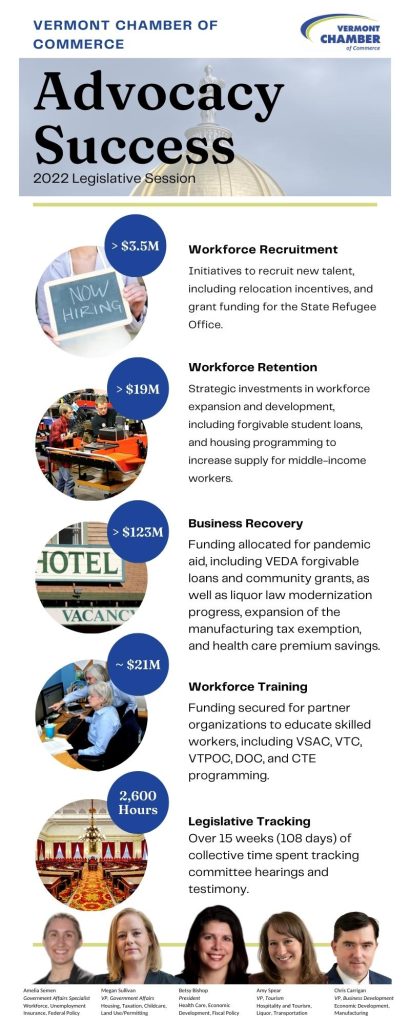
The Vermont Chamber succeeded on most of our 2022 legislative session agenda items, including retaining Vermont workers, helping businesses emerge from the pandemic, increasing workforce housing supply, and recruiting new workers to Vermont:

Workforce Recruitment:

  • Over $3.5 million was secured for workforce recruitment initiatives , including $3 million for relocation incentives, and $500,000 to the State Refugee Office for grants to support increased in-migration and retention of New Americans.

Workforce Retention:

  • $1.5 million was allocated for a two-year pilot program for a regional workforce expansion system, $250,000 for a Special Oversight Committee on Workforce Expansion and Development and $2.5 million in forgivable loans for college graduates who commit to work in Vermont for two years after graduation.
  • Included in the final omnibus housing bill was $15 million for the Missing Middle Homeownership Development program to increase the supply of housing for middle-income workers. There are also funds for an expansion of the priority housing project program and funding to increase the supply of rental units through grants to property owners.

Workforce Training:

  • $15 million was secured for a Career and Technical Education Construction and Rehabilitation Learning Program and Revolving Loan Fund through Vermont Housing and Conservation Board to rehab decrepit buildings and creative housing units.
  • Additional funding includes $3 million secured for the Vermont Student Assistance Corporation, $1.5 million to the Department of Labor for a Vermont Work-Based Learning and Training Program, $387,000 to Vermont Technical College for a skilled meat cutter training/apprenticeship facility, $250,000 for the Vermont Professionals of Color Network to provide business coaching and training.
  • The Department of Corrections was granted $420,000 to address vocational enhancement needs and $300,000 to establish a community reentry pilot program.

Business Recovery:

  • $38 million was also secured for business recovery programs, including $19 million for Vermont Economic Development Authority forgivable loans, $40 million for Community Recovery and Revitalization Grant Program, and $9 million for Creative Economy Grants.
  • Several provisions in a liquor law modernization bill will be beneficial for the hospitality industry, including moving ready-to-drink cocktails (RTDs) into the wholesale/retail space, permitting first-class licensees to sell RTDs, staggered vs. annual license renewals, and clarification for licensees to participate in the rare and unusual product raffles.
  • $17.7 million of continued savings were secured for health care premiums for small businesses using the Vermont Health Connect.
  • The manufacturing tax exemption expansion would exempt machinery and equipment used in integrated production operations and all ancillary processes between raw materials and finished goods, as well as some secondary packaging processes.

While there were many wins for the business community this session, the Legislature failed to deliver on key workforce recruitment efforts by not passing an allocation for relocation marketing or a full tax exemption on military retirement income. Even so, House and Senate leaders will head into the campaign season with a strong record of supporting the Vermont Chamber agenda and the Vermont business community. From our annual Vermont Economic Conference to our State to Main policy podcast series, to supporting the Vermont Declaration of Inclusion initiative, the Vermont Chamber once again set the tone for making Vermont a better, more vibrant place to live, work, and play.

Betsy Bishop, of East Montpelier, is the President of the Vermont Chamber of Commerce, whose mission is focused on creating an economic climate conducive to business growth while enhancing Vermont’s quality of life.

 

Megan Sullivan, of Jericho, is the Vice President of Government Affairs at the Vermont Chamber of Commerce, whose mission is focused on creating an economic climate conducive to business growth while enhancing Vermont’s quality of life.
 

Child Tax Credit and Military Income Exemption Outcome Uncertain

Child Tax Credit and Military Income Exemption Outcome Uncertain

Tax relief for Vermonters was a top priority for Governor Scott this year, but the measures passed in H.510 did not meet the minimum requirements he outlined, suggesting an uncertain outcome. The bill largely focused on a child tax credit with a price tag of $31.7 million, which would provide an up to $1,000 annual payment to qualified families with children under the age of 5. Unfortunately, this tax credit is not aimed at addressing childcare affordability, a contributing factor to the workforce crisis, and would make funding a childcare system in future years ever more challenging. At issue with the Governor, however, is not the child tax credit specifically but rather his priority to significantly expand the earned income tax credit and provide a full exemption of pensions for military retirees.

Under H.510 only the first $10,000 of income of military retirees would be exempt until social security starts, at which point a military retiree would be required to pick one exemption, either social security or military pension. This modest exemption will get Vermont off the list of States that offer no exemption but does not go far enough to honor the service of military retirees or make Vermont an attractive option for the retention and recruitment of these retirees to start a second career here. These differences may ultimately be enough to gain the Governor’s support even though they don’t include all of his priorities.

Manufacturing Tax Exemption Passes

Manufacturing Tax Exemption Passes

Expanding the manufacturing tax exemption has passed the House and Senate in the H.738 Miscellaneous Tax bill and is now headed to the Governor’s desk. If signed into law, the expansion would exempt machinery and equipment used in integrated production operations and all ancillary processes between raw materials and finished goods, as well as some secondary packaging processes. The Vermont Chamber advocated for and supported this change, which will modernize Vermont’s tax law, enhance workforce recruitment and retention, modernize facilities, and make Vermont competitive with the 33 other states that have similar exemptions. 

$8.3 Billion Budget Approved

$8.3 Billion Budget Approved

The final bill to pass this session was the $8.3 billion budget, which provides the funding for general government spending and the major policy bills this session. It invested in broadband buildout, childcare providers, and water and wastewater infrastructure to provide communities with the resources they need to attract new workers and families. It provided $50 million for the Vermont Housing Conservation Board, a $20 million investment in the missing middle home ownership development program and manufactured housing, and $20 million for the Vermont Housing Improvement Program to update rental housing units. The budget also allocated a total of $137.8 million in community, workforce, and economic development programs, many of which the Vermont Chamber fought for this session. The budget also included $185 million in energy focused initiatives including weatherization, energy efficiency grants for towns and electrification initiatives. For more budget details, listen to this VPR report.

Omnibus Housing Bill Passes

Omnibus Housing Bill Passes

In the fading hours of the legislative session the omnibus housing bill was passed, a priority for the Vermont Chamber, legislators, and the Governor. Getting to this outcome included difficult negotiations and impassioned speeches to ensure that the meaningful housing provisions could pass without garnering a veto from the Governor, who continually stated his opposition to a change in Act 250 governance included in the House-passed version. That provision is included in S.234 which also passed, but it will undoubtedly be vetoed by the Governor.

Included in the final omnibus housing bill is $15 million for the Missing Middle Homeownership Development program which addresses workforce needs by increasing the supply of housing for middle income earners. There are also funds for manufactured homes, bylaw modernization grants, and an expansion of the priority housing project program. Another housing bill also passed this session and will provide funding to increase the supply of rental units through grants to property owners.

Economic and Workforce Development Bill Passes Despite Veto Concerns

Economic and Workforce Development Bill Passes Despite Veto Concerns

The House and Senate passed a $99.5 million economic and workforce development bill, sending it to the Governor’s desk. For the over 100-page omnibus bill, the Conference Committee put in long hours and late nights to reach a compromise, including a $19 million VEDA forgivable loan program with a cap of $350,000 or six months of operating expenses, and an eligibility criteria based on at least a 22.5% reduction of adjusted net operating income during 2020 and 2021 combined. The bill includes $9 million in creative economy grants and a total of $10 million for the Community Recovery and Revitalization Grant Program, which  expands eligibility for nonprofits and municipalities doing infrastructure improvements and community development activities. However, the bill only includes a little over $3 million for relocation incentives and nothing for recruitment marketing, which was a priority for the Governor.

The minimum wage hike was deleted from the bill, but the unemployment insurance supplemental benefit provision remained and became even more onerous and expensive for the Department of Labor to administer. Beginning July 1, 2022, the maximum weekly benefit would increase by $60, then sunset in three years or when $8 million is drawn down from the UI Trust Fund. At that point, the benefit would increase by $25 until an additional $92 million is drawn down from the UI Trust Fund. The bill optimistically contains plans for the Department to meet this goal ahead of schedule, which the Department repeatedly testified is not feasible.

The Vermont Chamber worked closely with the committees of jurisdiction and the administration to ensure businesses will receive the support they need to recover. While many of our priorities were addressed, the bill contains absolutely no plan to recruit workers to Vermont, a glaring omission amid the severe labor shortage. Due to this exclusion, the Governor’s veto threat lingers as legislators adjourn.

As Session Winds Down, Vetoes Increase

As Session Winds Down, Vetoes Increase

With a high approval rating and little concern for the campaign season ahead, Governor Phil Scott exercised his veto authority on six bills already in 2022, for a record 29 in his six year tenure. In February, he vetoed a contractor registry, a prohibition of firearms in hospitals, and amendments to the Charter of the Town of Brattleboro to allow 16 and 17-year-olds to vote. Just last week he doubled his vetoes, sending back the pension reform bill, amendments to the Charter of the City of Burlington, and the Clean Heat Standard.

The Legislature had the votes to override the veto of the pension reform , but Governor Scott continues to clearly state which of his priorities are non-negotiable. has signaled that if bills come to his desk with provisions he opposes, or lacking sufficient funding for his priorities, more vetoes will follow. As legislators adjourned, leadership chose not to set a date to return to consider further action on vetoes, giving the Governor the final say leading into election season.

Vermont Chamber Investment in Advocacy Pays off for Businesses

Vermont Chamber Investment in Advocacy Pays off for Businesses

The 2022 legislative session occurred amidst the stark reality that Vermont has 26,000 job openings and an unemployment rate of 2.7%. Even if every one of those nearly 9,000 Vermonters were hired today, we would still have just over 17,000 open jobs. Compounded by the fact that 25,500 less people are participating in the workforce than pre-pandemic, it was clear that the foundation for the Vermont Chamber’s advocacy this legislative session had to be addressing our workforce shortage and ensuring businesses weren’t burdened with new laws that would constrain their ability to emerge from the pandemic. The Vermont Chamber succeeded on most of our initial agenda items, including: 

  • Retaining Vermont workers with investments in training for workers in the trades, nursing, and mental health fields
  • Helping businesses emerge from the pandemic by providing forgivable loans, capital investments, and support for community revitalization and arts organizations
  • Increasing workforce housing supply through the Vermont Rental Housing Investment Program and the Missing Middle Homeownership Development Program
  • Providing increased tourism marketing to support the hospitality industry
  • Expanding the exemption of manufacturing inputs from sales and use tax
  • Providing continued savings on health care premiums for small business
  • Recruiting new workers to Vermont with a continuation of relocation incentives and exempting military pensions to attract retirees re-entering the workforce
  • Avoiding new costs like mandated wages, additional unemployment insurance burdens, and technology taxes

While Vermont businesses will continue to battle the ongoing impacts of the pandemic, including a constrained labor force, higher wages, reduced hours, 8.3% inflation, and endless supply chain problems, progress was made on many fronts due to the increased support of our members and our dedicated five-person Vermont Chamber advocacy team. House and Senate leaders on these issues will head into the campaign season with a strong record of supporting the Vermont Chamber agenda, and the Vermont business community. From our annual Vermont Economic Conference, to our State to Main policy podcast series, to supporting the Vermont Declaration of Inclusion initiative, the Vermont Chamber once again set the tone for making Vermont a better, more vibrant place to live, work, and play.

Legislature on Track to Extend Health Insurance Savings for Small Businesses

Legislature on Track to Extend Health Insurance Savings for Small Businesses

H.489 is on track to pass both the House and the Senate allowing $17.7 million in health insurance cost savings to be extended to small businesses and their workers for another year. Last year, the markets were separated because there were federal subsidies that protected individuals from rate hikes. The plan was that the federal government would continue those subsidies, but that has yet to happen. Even so, the Legislature approved the continuation of this direction, hoping Congress will act. Meanwhile, there will be a working group to develop state alternatives to continue the practice without harming either group. This effort is especially timely as provider rates are likely to increase for plan year 2023 as has been forecasted in a mid-year review of hospital budgets at the Green Mountain Care Board.