
Workforce, Education, and Talent Development | Vermont Solutions Summit Policy Roundtable

Workforce, Education, and Talent Development

Vermont Solutions Summit Policy Roundtable

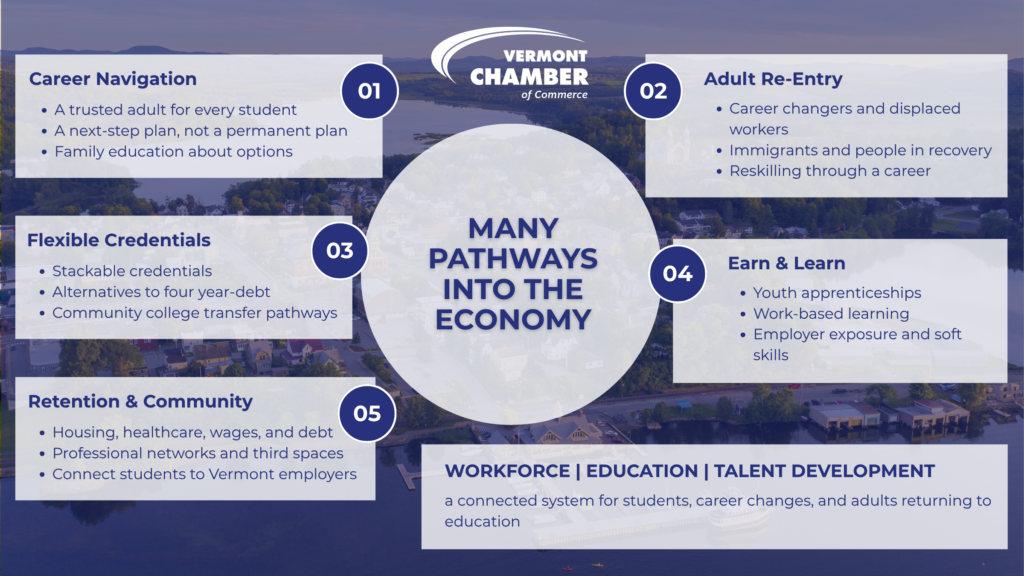
Workforce roundtable graphic that highlights points made in the article about the 2026 Solutions Summit policy roundtable

At the Vermont Solutions Summit, business leaders, policymakers, and community partners examined the scale of Vermont’s workforce challenge and opportunities to connect more people with pathways into and back into the workforce.

Participants cited roughly 5,000 graduating students each year compared with about 17,000 people leaving Vermont’s workforce. The gap underscores why Vermont cannot rely on a single pipeline from education into employment and points to the need for multiple pathways for students, career changers, displaced workers, immigrants, people in recovery, and experienced workers entering new fields.

Participants highlighted promising programs already operating in Vermont, including youth apprenticeships, early college, work-based learning, and industry exposure. The challenge is fragmentation, with access varying by school, location, or awareness of a particular program.

Retention also requires more than a job opening. Housing and healthcare costs can shape whether young Vermonters stay and whether experienced workers move here. Vermont colleges bring thousands of people into the state, but students need meaningful exposure to employers and communities if they are to picture a life here after graduation.

Heading into 2027, participants identified opportunities for a more connected approach, including statewide career navigation, trusted adults for students, replicable apprenticeships, stackable credentials, clearer transfer pathways, and adult reskilling. Participants also called for involving young people directly and measuring which local programs lead to employment and retention. The aim is to make successful pathways visible and available across Vermont while preserving the local responsiveness that made them work.

Megan Sullivan

Vice President of Government Affairs

Economic Development, Fiscal Policy, Healthcare, Housing, Land Use/Permitting, Technology
RECENT NEWS

Permitting, Regulation, and Predictable Investment | Vermont Solutions Summit Policy Roundtable

Permitting, Regulation, and Predictable Investment

Vermont Solutions Summit Policy Roundtable

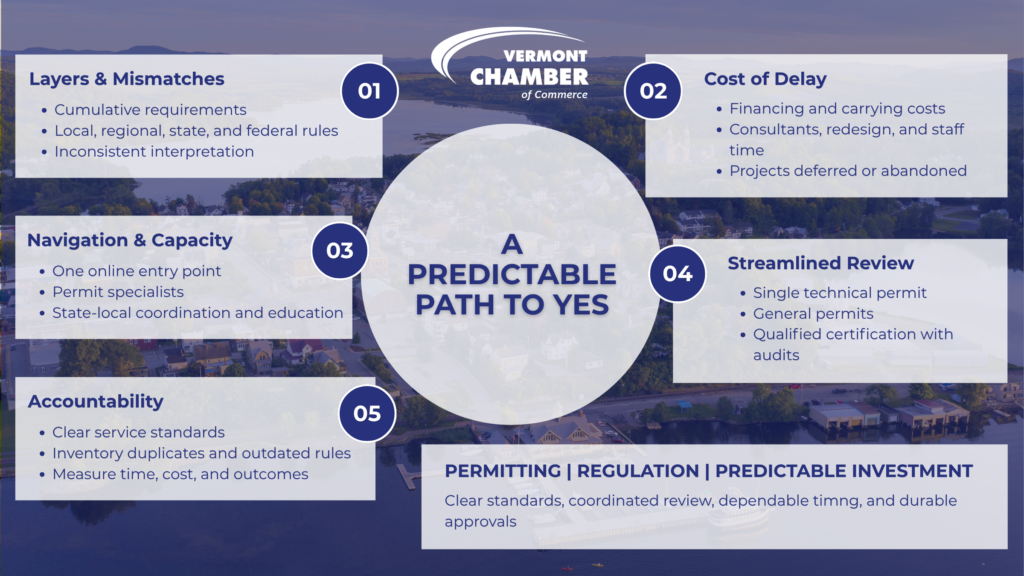
Permitting roundtable graphic that highlights points made in the article about the 2026 Solutions Summit policy roundtable

At the Vermont Solutions Summit, the permitting and regulation roundtable returned repeatedly to one priority: predictability.

Participants did not define success as the absence of standards, but as a system where applicants can understand the rules, navigate reviews in a clear sequence, receive decisions within dependable timeframes, and trust that approvals will not be repeatedly reopened through overlapping processes.

Delays can create significant costs before a project creates a job, home, or tax dollar, including financing, consultants, redesigns, and staff time. Those costs can grow when local, regional, state, and federal requirements overlap or conflict. Participants also noted that some applicants would be willing to pay a reasonable fee for faster, dependable review when the cost of delay is greater.

Ideas discussed included a single online entry point, stronger state and local coordination, review of outdated or duplicative rules, consistent review standards, and greater use of qualified professionals to certify compliant work. A trust-but-verify approach, supported by audits and enforcement, was also discussed to focus limited staff time on more complex or higher-risk applications.

Heading into 2027, the conversation pointed toward moving regulatory reform from a general promise to a defined work plan, with clear responsibilities and measures of whether changes reduce time and cost without weakening environmental or public protections. The clearest outcome was not a call to say yes to every project, but for a navigable path to yes when a project meets clear standards.

Megan Sullivan

Vice President of Government Affairs

Economic Development, Fiscal Policy, Healthcare, Housing, Land Use/Permitting, Technology
RECENT NEWS

Healthcare Affordability and the Cost of Doing Business | Vermont Solutions Summit Policy Roundtable

Healthcare Affordability and the Cost of Doing Business

Vermont Solutions Summit Policy Roundtable

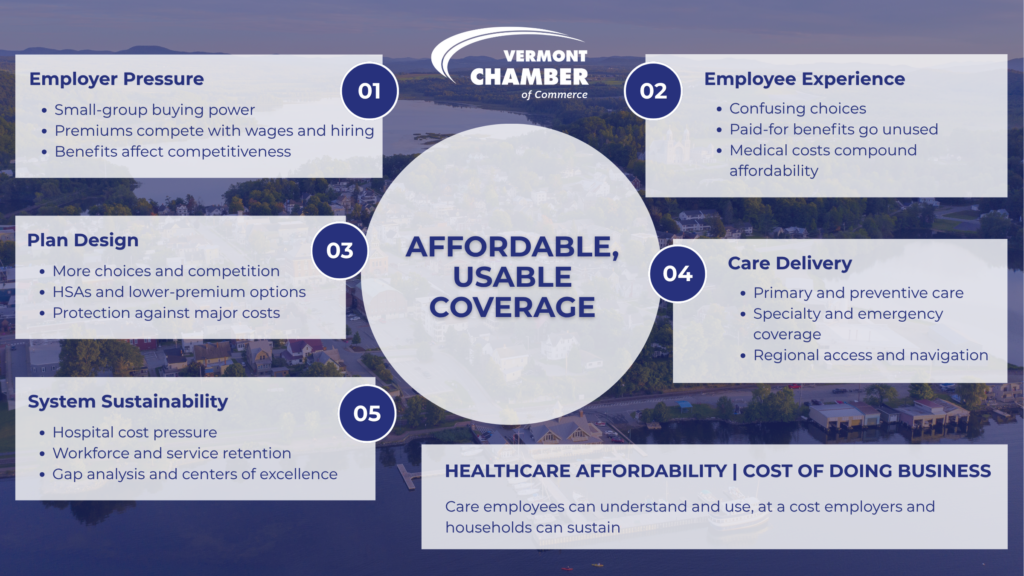
Healthcare roundtable graphic that highlights points made in the article about the 2026 Solutions Summit policy roundtable

At the Vermont Solutions Summit, business leaders, policymakers, and community partners examined how healthcare affordability is affecting employers and employees.

For employers, healthcare is no longer simply a benefits issue. It is increasingly connected to wages, workforce, and competitiveness. Small employers described the difficulty of competing with the purchasing power available to larger groups, while rising premiums can absorb resources that might otherwise support wages, hiring, or investment.

Affordability was only part of the conversation. Participants discussed employees’ declining coverage they do not understand and the need for more choices at different price points, including access to primary and preventive care. At the same time, lower premiums cannot be the only measure of success. Network adequacy, regional access, quality, and provider stability all affect whether coverage works when employees need care.

Complexity adds another challenge. Making coverage easier for employees to understand and use can help them make better use of the benefits already available to them, while hospitals face pressure to reduce costs, retain staff, and preserve services.

Heading into 2027, the discussion emphasized looking at the total cost carried by employers and households, not simply where that cost appears within the system. Participants identified small-group purchasing power, the range and clarity of coverage options, primary and preventive care, regional access, and hospital sustainability as interconnected considerations. The economic objective is coverage that employees can understand and use, and that employers can continue to offer.

Megan Sullivan

Vice President of Government Affairs

Economic Development, Fiscal Policy, Healthcare, Housing, Land Use/Permitting, Technology
RECENT NEWS

Economic Growth, Tax Policy, and Competitiveness | Vermont Solutions Summit Policy Roundtable

Economic Growth, Tax Policy, and Competitiveness

Vermont Solutions Summit Policy Roundtable

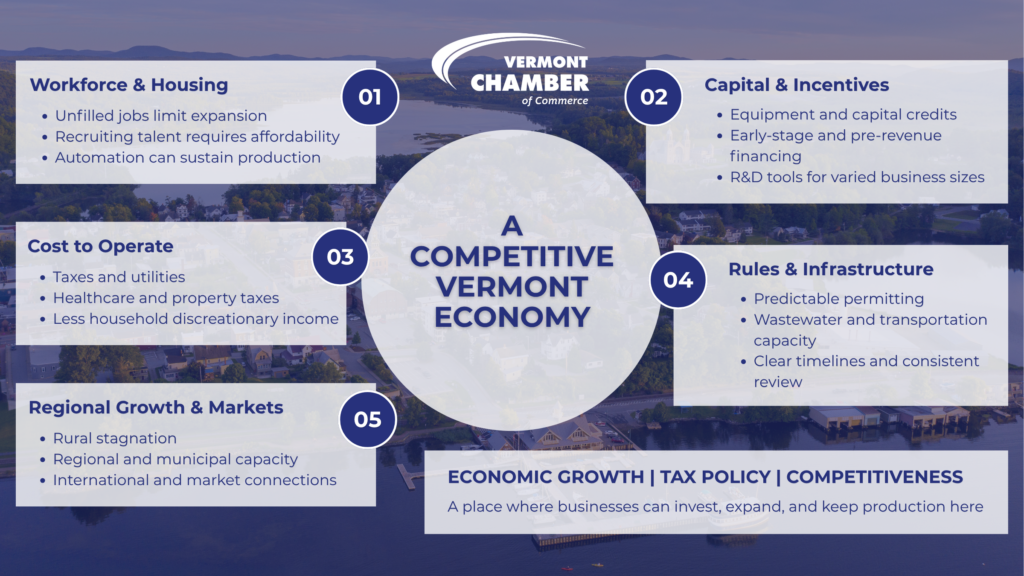
Economic growth roundtable graphic that highlights points made in the article about the 2026 Solutions Summit policy roundtable

At the Vermont Solutions Summit, business leaders, policymakers, and community partners examined how Vermont’s economic development tools align with the conditions businesses are navigating today.

Employers described demand for their products and interest in expanding, but also the realities that can make growth difficult. Workforce shortages and housing constraints can limit hiring, while high operating costs and regulatory uncertainty can influence decisions about where to invest.

Those conditions also affect the role incentives can play. When businesses are already struggling to fill existing positions, incentives tied primarily to adding jobs may have limited value. Participants pointed instead to capital investment, equipment, and automation. Automation was discussed as a way to sustain production, reduce injuries, and keep work in Vermont. The conversation also highlighted different capital needs across business stages, from startups seeking early capital to established employers considering their next investment.

Where that investment occurs has broader economic implications. Participants noted that when production is outsourced or an expansion occurs elsewhere, Vermont can lose supplier activity, payroll, tax base, and the local spending that follows. They also emphasized that incentives alone cannot compensate for delays, overlapping regulation, or infrastructure limitations.

Heading into 2027, the discussion pointed toward better aligning economic development tools with capital investment, research and development, automation, and business stage while maintaining clear measures of public value. It also reinforced the need for a simpler, more predictable path for businesses to invest, expand, and operate in Vermont.

Megan Sullivan

Vice President of Government Affairs

Economic Development, Fiscal Policy, Healthcare, Housing, Land Use/Permitting, Technology
RECENT NEWS

Vermont Chamber and NBT Bank to Host Free Economic Insights Webinar

Vermont Chamber and NBT Bank to Host Free Economic Insights

July 8 conversation with Ken Entenmann will translate national economic signals into practical insight for Vermont businesses

The Vermont Chamber of Commerce and NBT Bank will host a free Economic Insights webinar on Wednesday, July 8, featuring Kenneth J. Entenmann, CFA®, Chief Investment Officer and Chief Economist at NBT Wealth Management.

At a time when businesses are navigating interest rates, inflation, labor market shifts, consumer spending, and market volatility, Entenmann will help translate the latest economic signals into practical insight for Vermont employers and business leaders. At the same time, rapid advances in artificial intelligence are reshaping investment markets, productivity, and long-term economic expectations, creating new opportunities alongside new uncertainty.

For Vermont employers, these national economic forces have immediate consequences. They influence financing costs, consumer spending, hiring decisions, capital investments, and business planning. Businesses and organizations that understand the signals driving today’s economy will be better positioned to adapt and make informed decisions in an increasingly unpredictable environment.

During the webinar, Entenmann will provide clear, data-informed perspective on the economic conditions businesses are facing now and what they should be watching in the second half of 2026. The discussion will explore interest rates, inflation, consumer spending, labor market trends, AI-driven market activity, and the broader economic outlook.

“Business leaders are making critical decisions in an economy that is changing rapidly,” said Amy Spear, President of the Vermont Chamber of Commerce. “Economic uncertainty isn’t a reason to wait; it makes timely information even more valuable. This conversation is designed to help employers cut through the headlines, understand what the data is telling us, and make more informed decisions about investment, hiring, and growth. The Vermont Chamber is committed to connecting businesses with the economic insight, relationships, and resources they need to plan with confidence.”

Entenmann brings more than 33 years of investment experience and oversees more than $6 billion in assets under management and administration across Trust, Custody, Retirement, Institutional, and Individual accounts. Prior to joining NBT Bank, he served as Director of Investment Management at Alliance Bank. He holds a bachelor’s degree in Applied Economics and Business Management from Cornell University, an MBA from the William E. Simon Graduate School of Business Administration at the University of Rochester, and the Chartered Financial Analyst (CFA®) designation.

The Economic Insights webinar series, powered by NBT Bank, connects Vermont businesses with timely economic analysis and practical guidance to support sound planning and decision-making in a rapidly evolving marketplace.

Registration is free and open to all.
CONNECT WITH OUR TEAM

Jeff Wise

Senior Director of Programming

RECENT NEWS


Vermont Chamber and NBT Bank to Host Free Economic Insights Webinar on Inflation, Interest Rates, AI, and Market Outlook

June 26, 2026
Vermont State House in Montpelier at Dusk


Ways Legislative and Executive Action or Inaction Could Impact Businesses After the 2026 Session

June 5, 2026

SEE ALL NEWS

Secretary of State Sarah Copeland Hanzas Connects with Business Leaders at the Wellspring Forum

Secretary of State Sarah Copeland Hanzas Connects with Business Leaders at the Wellspring Forum

Stowe, VT (June 4, 2026) – Secretary of State Sarah Copeland Hanzas connected with Vermont business leaders at von Trapp Family Lodge & Resort today for the latest installment of the Wellspring Forum series. Each event in the series brings together top business and policy leaders for a thoughtful and engaging discussion on pressing economic issues and is moderated by Vermont Chamber President Amy Spear.

“The Wellspring Forum series creates space for meaningful conversations between business and policy leaders about the issues shaping Vermont’s future,” stated Spear. “Strong communities, a healthy civic culture, and a vibrant economy are deeply interconnected. We appreciate Secretary Copeland Hanzas joining us for a thoughtful discussion on the role employers can play in fostering civic engagement and strengthening community connections.”

Secretary Copeland Hanzas brings a unique statewide perspective on civic participation at a moment when many Vermonters are experiencing economic pressure, uncertainty, and polarization. She discussed the growing connection between civic responsibility, workforce culture, community trust, and long-term economic resilience. Business leaders shared perspectives on the importance of maintaining strong communities, fostering civic engagement in the workplace, and creating the conditions necessary to attract and retain workers and families in Vermont.

“Vermont’s future depends on our ability to build communities where people feel connected, engaged, and invested,” said Secretary of State Sarah Copeland Hanzas. “Civic participation is not separate from economic success; it is part of what makes our communities resilient. I appreciate the thoughtful conversation with Vermont business leaders about how we can work together to strengthen trust, encourage civic participation, and help our communities thrive.”

The Wellspring Forum series is supported by NBT Bank and AT&T. The event’s name draws inspiration from former Governor James H. Douglas, who once said: “I am often reminded that the wellspring of Vermont liberty flows from Main Street, not State Street.”

CONNECT WITH OUR TEAM

Jeff Wise

Senior Director of Programming

RECENT NEWS

Vermont Chamber to Host National Civics Bee® State Finals Competition for Middle Schoolers in Stowe, Vermont

Vermont Chamber to Host National Civics Bee® State Finals Competition for Middle Schoolers in Stowe, Vermont

(Stowe, VT) On Monday, June 8th, The Vermont Chamber of Commerce will host a 2026 National Civics Bee State Finals Competition aimed at encouraging more young Americans to engage in civics and contribute to their communities. Middle school students from across Vermont will demonstrate their civics knowledge, discuss how they would solve a problem facing their community, compete for cash prizes, and the opportunity to move on to the National Championships in Washington, D.C., in Fall 2026.

More information about the event can be found here: Civics Bee Vermont Finals

WHO: The top ten Vermont middle school students from regional Civics Bee competitions. State Final judges include Martha Deiss, Education Program Coordinator (Social Studies) – Agency of Education, Robyn Palmer, Civic Engagement Director – Secretary of State’s office, Chris Sheehan, Founder – Twinfield Democracy Project. The Emcee of this year’s finals is Denise Smith, Executive Director – VT Council on Rural Development. The competition is open to the public.

WHAT: The National Civics Bee is an annual competition that encourages young Americans to engage in civics and contribute to their communities.

WHEN: Monday June 8th 4:00 PM – 6:00 PM

WHERE: Stowe Middle/High School, 413 Barrows Road, Stowe, VT

About the National Civics Bee®
The National Civics Bee is a program of the U.S. Chamber of Commerce Foundation, is an annual nonpartisan competition aimed at improving civics education and literacy among middle school students, their families, and communities. The National Civics Bee helps elevate civics as a national priority through a network of state, regional, and local organizations across the country. The National Civics Bee is made possible through the generous support of its founding partner, the Daniels Fund, as well as Carnegie Corporation of New York, Citizen Travelers, and other funders.

About the Vermont Chamber of Commerce
The Vermont Chamber of Commerce is dedicated to advancing the Vermont economy. Trusted by the businesses that make living, working, and thriving in Vermont possible, we prioritize collaboration and uphold the core values that define our state. As the preeminent not-for-profit business organization, we advocate, build community, and provide resources for businesses statewide.

CONNECT WITH OUR TEAM

Jeff Wise

Senior Director of Programming

RECENT NEWS


Data Privacy Bill Advances with Significant Changes Following Intense Debate

May 29, 2026


Conference Committees Finalize Education Reform and Yield Bills

May 29, 2026

SEE ALL NEWS

Vermont Military Families Benefit from Diaper Drive at State House

Vermont Military Families Benefit from Diaper Drive at State House

On Thursday, May 14, lawmakers and citizens came together in the State House lobby to support the families of deployed Vermont National Guard members. Donations of over 2,600 diapers, thousands of wipes, and over $450 in individual monetary donations were collected throughout the day. Generous donations of $1,000 from Veterans Guardian, $1,000 from Veteran Benefits Guide, and $500 from American Legion, also contributed to the effort to support the households with infants and toddlers of affected Vermont Guard families.

Running through the Vermont Family Readiness Program with support of the Vermont Chamber of Commerce and in coordination with the Vermont National Guard and Veteran Affairs Caucus, the event was focused on supporting families in Vermont communities who are navigating the challenges of deployment.

During deployment, families often face both financial and logistical pressures. Some service members experience a reduction in income during deployment compared to their civilian roles. At the same time, spouses at home may need to scale back or step away from work to manage childcare and household responsibilities independently. Diapers and wipes are amongst ongoing expenses that place added strain on family budgets, particularly during periods of transition and uncertainty.

The donations will be distributed directly by the Family Readiness Team to Vermont military families, ensuring that support reaches those who need it most in a timely and practical way.

Megan Sullivan

Vice President of Government Affairs

Economic Development, Fiscal Policy, Healthcare, Housing, Land Use/Permitting, Technology

Tourism Economy Day Brings Business and Policy Leaders Together at the State House

Tourism Economy Day Brings Business and Policy Leaders Together at the State House

On Thursday, April 16, tourism and hospitality industry leaders gathered at the State House to engage with legislators and administration officials to highlight the collective contributions of the visitor economy to Vermont. Tourism Economy Day, convened by the Vermont Chamber of Commerce and Ski Vermont, brought businesses together to advocate for a strong Vermont visitor economy.  

Industry leaders shared perspectives during a joint legislative hearing with the House Committee on Commerce and Economic Development and the Senate Committee on Economic Development, Housing and General Affairs, offering real world insight into the opportunities and challenges facing Vermont’s tourism economy.  

Tourism Economy Day brought together business leaders, legislators, and administration officials, creating space for direct conversation between policymakers and the employers who power Vermont’s visitor economy. Industry voices from across the state shared perspectives rooted in their day-to-day operations and community impact.  

“A thriving tourism economy means vibrant communities and opportunity across Vermont,” said Amy Spear, President of the Vermont Chamber of Commerce. “Tourism Economy Day ensures lawmakers hear directly from businesses. While the industry remains a major economic driver, employers are navigating workforce shortages, housing availability challenges, and rising costs.”  

Business leaders highlighted both the strengths of Vermont’s tourism economy and the challenges facing the industry. Key themes included workforce shortages, housing availability and affordability, healthcare costs, and declining Canadian visitation. Leaders also emphasized the importance of strengthening career pathways in hospitality, from culinary training to management and entrepreneurship.  

“Tourism businesses, including our ski areas, are a key driver of visitation and help support many rural communities across the state,” said Molly Mahar, President of Ski Vermont. “In addition to affordability issues and workforce and housing shortages, businesses also face an inefficient and inconsistent permitting process that adds cost and time to projects, affecting businesses’ ability to grow and remain competitive. Tourism Economy Day ensures those realities are part of the conversation as policymakers look ahead.”

The day’s programming included a joint legislative hearing, a presentation from the Vermont Department of Tourism and Marketing, and a conversation with Lieutenant Governor John Rodgers.  

Commissioner Heather Pelham shared updates on visitation trends, marketing strategies, and the impact of tourism on the state’s economy. The day concluded with an acknowledgment on the House Floor recognizing tourism’s vital role in Vermont and declaring April 16, 2026, Tourism Economy Day.  

Tourism Economy Day highlights the role of tourism in advancing the Vermont economy through collaboration between businesses and policymakers. Vermont’s visitor economy has a $4.2 billion annual economic impact and employs 9% of the Vermont workforce. 

CONNECT WITH OUR TOURISM AND HOSPITALITY EXPERT

Amy Spear

President

Fiscal Policy, Taxation, Tourism and Hospitality, Workforce Development

RECENT NEWS

Manufacturing Day Brings Employers and Lawmakers Together at the State House

Manufacturing Day Brings Employers and Lawmakers Together at the State House

On Thursday, April 2, industry leaders from Vermont’s manufacturing sector, gathered at the State House to connect with legislators and political leaders to highlight the industry’s significant contributions to Vermont’s economy, and to present the challenges and opportunities facing Vermont’s manufacturers.

With over 50 manufacturers from across Vermont in attendance, the day reflected broad, statewide engagement, several offering insightful testimony in legislative hearings with House and Senate committees. The testimony given included representatives and business owners from Nolato, Built By Newport, Vermont Frames, Chroma Technologies, and Vermont GaN Tech Hub. The day was also highlighted by an open forum and Q&A with Lieutenant Governor John Rodgers, a press conference, and the reading of a resolution on the House Floor declaring April 2, 2026 ‘Vermont Manufacturing Day.’

“Manufacturing is one of the clearest pathways we have to grow Vermont’s economy. It supports communities across every region and creates opportunity for Vermonters to build careers, support their families, and stay rooted here,” said Amy Spear, President of the Vermont Chamber of Commerce.

Key issues and themes raised throughout the day focused on the sustainability and growth of Vermont’s manufacturing businesses by expanding existing companies, attracting new firms to the state, and growing the manufacturing technology talent pool through Centers of Technical Education (CTE). Along with the many growth opportunities presented, including the new research and development tax incentive, came the barriers to the industries’ success. At the top of the list is affordable housing for additional workforce, the complexity and complexity of permitting, property taxes, and the rising cost of health care.

Manufacturing’s Contribution to Vermont’s Economy
Vermont’s manufacturing industry generates $2.92 billion economic impact, representing 7% of Vermont’s gross state product (GSP). The business make-up 7% of Vermont’s workforce, supporting 26,600 jobs across diverse sectors of economic industry. Manufacturing plays a pivotal role in the growth and development of both rural and urban communities throughout Vermont, representing businesses that are renowned globally and at the forefront of innovation across various industries. These manufacturers contribute significantly to fostering strategic relationships between the state and neighboring regions, including New England, New York, Canada, as well as the broader local and global economy.

CONNECT WITH OUR TEAM

Megan Sullivan

Vice President of Government Affairs

Economic Development, Fiscal Policy, Healthcare, Housing, Land Use/Permitting, Technology
RECENT NEWS