
Vermont Legislators Launch New Caucus to Address Urgent Economic Challenges 

Vermont Legislators Launch New Caucus to Address Urgent Economic Challenges

Vermont legislators gathered Friday for the inaugural meeting of the Caucus for Vermont’s Economy, a bipartisan group of legislators that represents communities around the state, focused on advancing policies that strengthen the state’s economy and improve the well-being of Vermonters. The timing could not be more critical. The recently released Vermont Competitiveness Dashboard from the Vermont Futures Project underscores why: Vermont ranks last in the nation in economic momentum, 50th in workforce retention, 49th in population growth, and near the bottom in housing permits and business competitiveness. 

While these rankings paint a sobering picture, the caucus demonstrates that data is not destiny. By bringing together legislators from both the House and Senate, leaving party roles at the door, the group is creating a forum to turn information into action. The Caucus is led by Co-chairs Rep. Abbey Duke and Rep. Ashley Bartley, Rep. Jonathan Cooper (Clerk) and Reps. Chris Morrow and Kate Lalley (Communications). In preparation for the caucus, all legislators were surveyed to gauge interest and collect insights on the expertise members could bring. The result is a diverse and talented group, committed to looking at Vermont’s economic challenges from a “big picture” perspective. 

At the inaugural session, caucus leaders emphasized breaking down committee silos, fostering collaboration across the legislature, and bringing diverse perspectives to complex problems. Members shared priorities and ideas ranging from Vermont’s highly restrictive regulatory environment, housing, and creating a state in which Vermonter can thrive. The conversation highlighted that while Vermont faces real challenges, it also has clear opportunities to reverse trends when lawmakers act decisively together. 

The caucus aims to translate urgency into action. By focusing on adopting policies that grow the economy, and expanding opportunity for all Vermonters, the group hopes to move beyond gridlock and build a more resilient, competitive Vermont. For businesses and communities, the caucus launch is a signal that the state’s leaders are confronting difficult data with collaboration, creativity, and optimism, turning insight into meaningful solutions.  

CONNECT WITH OUR ECONOMIC DEVELOPMENT EXPERT

Megan Sullivan

Vice President of Government Affairs

Economic Development, Fiscal Policy, Healthcare, Housing, Land Use/Permitting, Technology
RECENT NEWS

Vermont Chamber Testifies on Economic Development: Data, Employers, and Policy Aligned for Action 

Vermont Chamber Testifies on Economic Development: Data, Employers, and Policy Aligned for Action

The Senate Committee on Economic Development, Housing, and General Affairs took testimony from both the Vermont Futures Project and Vermont Chamber of Commerce, grounding the conversation in data and employer experience. Committee Chair Sen. Alison Clarkson framed the discussion by stressing that understanding economic trends early will help shape meaningful economic development and housing policy this session. Lawmakers acknowledged that without aligning policy with economic realities, Vermont risks perpetuating trends that weaken its competitive position.

The data presented by the Vermont Futures Project highlighted that while quality of life remains a strength, core structural challenges, especially population decline and limited housing supply, are holding the state back. Vermont ranked near the bottom of the nation in population change and housing permits, as one of only three states experiencing net population loss in 2024. Committee members appreciated the comparative context, noting the recently released Vermont Competitiveness Dashboard from the Vermont Futures Project helps shift debate from anecdote to measurable outcomes.

Building on that foundation, the Vermont Chamber’s testimony focused on a set of pragmatic, data-informed economic priorities designed to support workforce availability, improve regulatory predictability, and align state policy with business needs. Businesses consistently report workforce scarcity, housing limitations, regulatory complexity, and cost pressures as interconnected constraints. Members around the table noted how these challenges play out in their districts, especially when companies cannot expand due to permitting uncertainty or cannot recruit due to housing shortages.

The Vermont Chamber’s workforce and economic development policy recommendations this year focus on six priority areas:

  • Regulatory Predictability and Streamlined Permitting – Compile and coordinate regulatory requirements across agencies to reduce uncertainty and delays
  • Effective Outreach and Coordination for Workforce Investments – Improve employer awareness of existing programs through trusted intermediaries and clear communication
  • Expanded Access to the Green Mountain Jobs Program – Broaden eligibility to include associate degrees and industry certifications reflecting the reality that nearly 70 percent of Vermont jobs do not require a four-year degree
  • Strengthened Hospitality and Visitor Economy Workforce and Funding – Align training with industry needs and support data informed marketing to stabilize demand and employment
  • Preservation of the Vermont Employment Growth Incentive VEGI – Remove the sunset on this investment tool to provide long term predictability for business decision making
  • Support for Automation to Preserve Jobs and Increase Productivity – Launch a study to design incentive structures that balance technology adoption with workforce upskilling

The testimony emphasized that the agenda is rooted in long-term strategy, realistic budget expectations, and employer feedback from across sectors. Committee members engaged deeply with each recommendation, expressing particular interest in regulatory transparency, workforce marketing, and expanded retention incentives. Questions underscored a shared understanding that Vermont’s economic challenges are intertwined, and effective policy must be coordinated, measurable, and grounded in data.

As the session unfolds, the Chamber will continue to work with legislators to refine and advance these priorities, ensuring that state policy supports economic competitiveness, workforce stability, and predictable conditions for business growth across Vermont

CONNECT WITH OUR ECONOMIC DEVELOPMENT EXPERT

Megan Sullivan

Vice President of Government Affairs

Economic Development, Fiscal Policy, Healthcare, Housing, Land Use/Permitting, Technology

RECENT NEWS

“I Think” Is Not a Tax Policy: Why Vermont’s Fiscal Choices Matter Right Now

“I Think” Is Not a Tax Policy: Why Vermont’s Fiscal Facts Matter Right Now

“I think” is not an economic strategy. Yet too often, tax debates drift away from data and lived experience and toward short-term fixes that feel expedient in the moment. This week’s discussion in House Ways and Means around H.R.1 and selective decoupling from federal tax provisions puts Vermont at a familiar and consequential crossroads following testimony from an expert witness that emphasized professional judgment, with limited supporting data or publicly shared analysis available at the time of publication. 


The issue before lawmakers is not whether Vermont faces fiscal pressure. It is whether the state continues a pattern of treating businesses as a fiscal backstop or chooses a path that strengthens affordability, predictability, and long-term economic stability. 

The lived experience of Vermont employers is clear, and it is not theoretical. Business Climate Survey results consistently show that employers’ top challenges are workforce shortages, taxes and fees, and housing. These pressures are interconnected. When costs rise in one area, they compound strain across the entire system. 

The overall business climate rating of 2.86 out of 5 captures that reality. Employers remain deeply committed to Vermont and their communities, but they are operating under rising costs, limited labor availability, and regulatory processes that often feel unpredictable or misaligned with economic conditions. That uncertainty is not academic. It directly affects business decisions. 

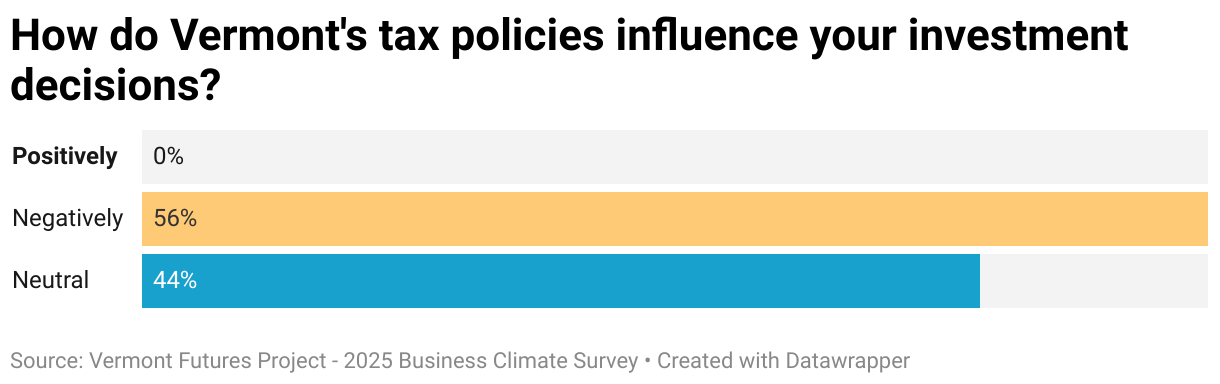
We see it clearly in investment behavior. More than one-third of Vermont employers anticipate making no investments in the next 12 months, while many others expect only minor investments. When asked how Vermont’s tax policies influence investment decisions, 56 percent say negatively, and zero percent say positively. This is not a signal to raise the cost of doing business. It is a warning that confidence is fragile and that policy narratives untethered from data carry real risk. 

Opening and Closing Rates of Establishments (#45 out of 50)

This moment also deserves context. Just last year, lawmakers rightly expressed concern about the impact of federal tariffs on Vermont businesses. There was bipartisan recognition that when external forces raise costs and disrupt supply chains, state policy should not compound that harm. That same logic applies here. Selectively decoupling from federal tax provisions that support investment and innovation would stack new state-level costs on top of existing federal pressures, undercutting the very stability policymakers sought to preserve when tariffs hit. 

Importantly, this is not a question of tax fairness or progressivity. Vermont already has one of the most progressive tax systems in the country, ranking near the top nationally according to the Institute on Taxation and Economic Policy. Thoughts that Vermont’s tax structure lacks progressivity are not supported by the data.   

Table of ITEP Tax (In)equality Index (#3 out of 51)

The real issue is cost containment and fiscal discipline. Vermont ranks 46th nationally in state government spending per capita. At the same time, nearly two thirds of employers say public funds are not being used efficiently to support economic growth. That disconnect matters. Businesses are being asked to absorb higher costs without seeing corresponding improvements in affordability or outcomes.


Table of State Government Spending (#46 out of 50)

This is why proposals to decouple from federal provisions like R&D expensing are so concerning. Decoupling would raise the cost of innovation in Vermont relative to neighboring states, increase tax code complexity, and penalize firms investing in productivity, technology, and higher-wage jobs. In a state with a shrinking workforce, productivity-led growth is not optional. It is essential. 

The Competitiveness Dashboard reinforces this point. Vermont ranks near the bottom nationally for business formation, investment momentum, and economic growth, while also ranking poorly on tax competitiveness. These are not isolated data points. They are signals of a system under strain that demand data-informed responses. 

Table of Total Effective Business Tax Rate (#51 out of 51)

The outcome Vermont should be pursuing is clear. Tax policy should align with data and provide consistency when businesses face external shocks, whether from tariffs, interest rates, or labor constraints. Affordability will not be achieved through short-term tax decisions or by repeatedly targeting employers. It will come from bending the cost curve in healthcare and housing, controlling spending growth, and creating an environment where businesses feel confident investing for the long-term because policy decisions are anchored in evidence. 

“I think” should not guide tax policy. The data already tells us what works. The choice now is whether Vermont is willing to follow it. 

CONNECT WITH OUR TAX EXPERT

Amy Spear

President

Fiscal Policy, Taxation, Tourism and Hospitality, Workforce Development

RECENT NEWS

Issue Updates from the State House | Week of January 13, 2026

Issue Updates from the State House

Week of January 13, 2026

A weekly snapshot of key legislative activity impacting Vermont’s business community. 

  • Land Use: The Senate Economic Development, Housing, and General Affairs committee reviewed updates to Act 250 regulations through Act 181. The Vermont Chamber is asking for specific technical corrections to Act 181 to achieve the legislative goal incentivizing critical housing creation in smart growth areas while also protecting critical natural resources in areas of statewide significance.
  • Housing: The House General and Housing committee continued to take testimony on what is working, and what is still needed to address Vermont’s housing crisis. With the robust input received, the committee is expected to start working on housing specific legislation in the coming weeks.
  • Employment Options for Newly Released People: The House Commerce and Economic Development and House Corrections and Institutions Committees heard testimony on vocational, training, and educational programs for individuals reentering the workforce after incarceration. These programs play a critical role in boosting workforce participation.
  • Tax Classifications: The House Ways and Means Committee heard testimony on the Property Tax Classifications Implementation Report, outlining the extensive resources needed to add a third classification targeting second homes by 2028. Many challenges need to be addressed before implementation, including unfunded town mandates, creation of dwelling use attestation forms for properties with over 4 dwelling units, and employee housing.
  • Mileage-Based User Fees: As Vermont prepares to transition from a flat annual EV fee to a per-mile EV charge in 2027, the Senate Transportation Committee heard testimony on implementation strategies.
  • Data Brokers: The House Commerce and Economic Development Committee has begun testimony on H.211, a data broker bill that, as amended, dramatically expands the definition of “data broker” and changes standing definitions. The existing data broker law was the result of hundreds of hours of stakeholder and lawmaker collaboration to carefully construct definitions that will not have unintended consequences. The draft throws out that work. The Vermont Chamber will be watching this bill to ensure necessary due diligence is done.
  • Education Spending: The Senate Finance Committee reviewed S.220, a bill that would cap education spending growth in 2028 and 2029 to help limit property tax increases. The proposal has faced strong opposition from education stakeholders, and from some members in committee. However, addressing Vermont’s affordability crisis will require confronting the unsustainable growth in education spending, and spending caps are increasingly viewed as a necessary if difficult step toward greater fiscal discipline and predictability for taxpayers.
  • Vermont Employment Growth Initiative (VEGI): The Senate Finance committee reviewed S.225, a bill that would repeal the sunset of the VEGI program. Making the program permanent would ensure continued access to this key economic development tool for business expansion and job creation.
  • Mediation Services: The Senate Economic Development, Housing, and General Affairs Committee reviewed S.173, a bill that would create a new state position offering mediation services to both public and private sector businesses and their employees’ collective bargaining units.
  • Advance Vermont: The Senate Economic Development, Housing, and General Affairs committee heard testimony from AdvanceVT on MyFutureVT, a program offering free online resources to support education and career advancement. Businesses are encouraged to use this tool to support employee retention and skills development efforts.
  • Permit Modernization: The House Environment committee heard testimony on modernizing Vermont’s housing permitting system, focusing on increasing cross-agency coordination, data entry, and consolidation of permit processes to a single point of entry using shared data. With development of a pilot program underway, agencies hope to reduce time and cost associated with building housing units.
  • Telecommunications: The House Energy and Digital Infrastructure committee heard testimony on H.527, a bill that extends the sunset on the Public Utilities Commission’s authority to approve telecommunications projects, keeping applications outside of the lengthy ACT 250 approval process. Preserving this authority ensures continued expedited procedures for broadband expansion and rural infrastructure investments.
  • Commercial Property Assessed Clean Energy Projects (C-PACE): The Vermont Chamber testified before the Senate Natural Resources Committee on S.138, a bill proposing to expand the PACE program to include commercial and industrial buildings. The expansion would allow business owners to finance energy improvements and repay the cost over time through a special assessment on their property tax bill.
  • Hospital Budgets: The House Health Care Committee received updates on last year’s legislation aimed at reducing hospital budgets and implementing a reference-based pricing model by 2028 in efforts to lower insurance rate increases and improve healthcare costs for Vermont ratepayers.
  • Revenue Forecast: The Vermont Emergency Board, House and Senate Appropriations, House Ways and Means, and Senate Finance committees reviewed an update to the state revenue forecast indicating revenue will be on par with previous estimates. Corporate income tax is expected to come in behind estimates, underscoring the need for stable and predictable policies to reduce further strain on the business community.

CONNECT WITH OUR TEAM

Megan Sullivan

she/her

Vice President of Government Affairs

802-522-6316

RECENT NEWS